5 AI DAM Platforms: Retrieval, ML & Scale Compared
Five AI DAM platforms compared on automated asset retrieval, machine learning performance data and scalability for large teams.
Every major DAM vendor now says "AI-powered" somewhere on their homepage. Most mean it in the loosest possible sense: a smart filename suggestion here, a metadata field pre-filled there. A handful have built something that actually changes how teams work.
Three capabilities separate AI DAMs that deliver from ones that are mostly a marketing label:
1. Automated content categorization and retrieval: the system understands what's inside an asset and makes it searchable by visual content, not just by whatever name someone happened to give the file.
2. ML for predictive asset performance: the system connects asset attributes to advertising performance data on the creative level, so teams can understand which creative concepts actually perform and can plan new concepts more likely to be winners.
3. Scalability for large teams and ad budgets: the system handles thousands of assets, multiple agencies, and multi-market rollouts without performance degrading. As creative volumes grow, it's important users can get work done efficiently without the system becoming a bottleneck.
Below is a comparison of five major AI DAM platforms on these three dimensions.
Automated asset retrieval
Most DAMs let you search by tag. The question is who created those tags: a human typing into a metadata field, or a model that read the content of the file.
Genuine automated retrieval means visual content recognition that runs at upload: the system watches video frames, reads scene composition, identifies elements such as hooks, formats, talent presence, text overlays and settings, and generates structured, searchable tags without anyone touching a keyboard.
A team that built this correctly can search for "UGC, vertical, price-reveal hook, outdoor setting" and get results across tens of thousands of assets instantly.
The gap in most tools is either that tagging requires human input, or that automated tagging uses a taxonomy strictly set by the platform, not leaving enough room for advertisers to customize things for their needs.
Machine learning for predictive asset performance
This is the capability almost no tool has in a meaningful form.
Performance data such as spend, ROAS, CPA, view rates, etc. live in Meta Ads Manager, TikTok Ads Manager, or an MMP. Asset files live in a DAM or a Drive. In most stacks these never talk to each other. Teams run manual exports, match asset names to ad names in spreadsheets, and produce reports that are already stale by the time they're read (if they're read at all).
ML for performance here means the DAM ingests ad performance data and surfaces it alongside the asset itself so a creative strategist can quickly pull up a concept, see which executions went live, and see how they performed without leaving the platform.
Over time this creates a structured picture of which visual attributes correlate with performance in your specific account, across your specific audience, so future creative concepts can be built with a higher chance of success from the start. That's the predictive layer most teams talk about wanting and almost none have.
Scalability for large teams
Scalability in DAMs breaks in a few specific ways. At small asset counts every system feels fine, because search quality issues and permission sprawl haven't compounded yet. At 10,000+ assets across six agencies and four markets, the gaps become structural.
Scalability isn't just storage capacity, it's whether the system can support growing teams and asset volumes. Some of the most typical things that break at scale include:
Guest access models that expose too much or too little.
Search performance that degrades when dealing with large asset volumes.
Approval workflows that aren't build for large numbers of stakeholders, and can't distinguish between markets or agencies.
Asset naming that is not fully automated, leading to naming errors and broken report data.
Slick UIs that feel great at low asset counts, but lack sufficient automation to keep work efficient when creative volumes grow.
Another aspect of scalability is the cost of the platform. Many platforms can quickly become prohibitively expensive when pricing is seat-based and you have large teams and external stakeholders you'd all want working on a single platform.
The platforms
Focal
Built specifically for performance advertising teams such as DTC brands, consumer apps, mobile gaming, travel advertisers and others that produce high volumes of ad creative and spend at least six figured per month on paid social.
Automated retrieval: Visual content recognition runs automatically at upload. Assets are tagged by what's in them — format, hook type, talent, setting, text overlay presence (frame-by-frame in videos), scene composition — making the library searchable by visual content without any manual metadata work. Works on video at the frame level.
ML performance data: Focal connects directly to Meta ads data, and supports direct uploads to Meta, TikTok, and YouTube. Performance data surfaces alongside assets in the library so teams see which creatives are live, which are testing, and how they're performing without leaving the platform. Focal is one of the few AI DAM platforms that close this gap natively, without additional 3rd party creative analytics tools needed.
Scalability: Multi-agency access model gives external teams a scoped view without exposing the full account. Naming convention enforcement runs automatically on every asset. Used by teams managing 25+ markets and handling 1000+ new creatives per month. There's also unlimited users on Starter, Plus, and Growth plans so having all your key stakeholders on a single platforms does not become an issue.
Best for: Performance ad creative teams who need the full brief-to-launch workflow — not just asset storage.
Honest limitation: Export integrations are available for Meta, TikTok, and YouTube for now (and Figma on the import side). Ads data is available from Meta with more platforms on the way, so if primary channels are AppLovin or Unity, the performance data connection isn't available yet.
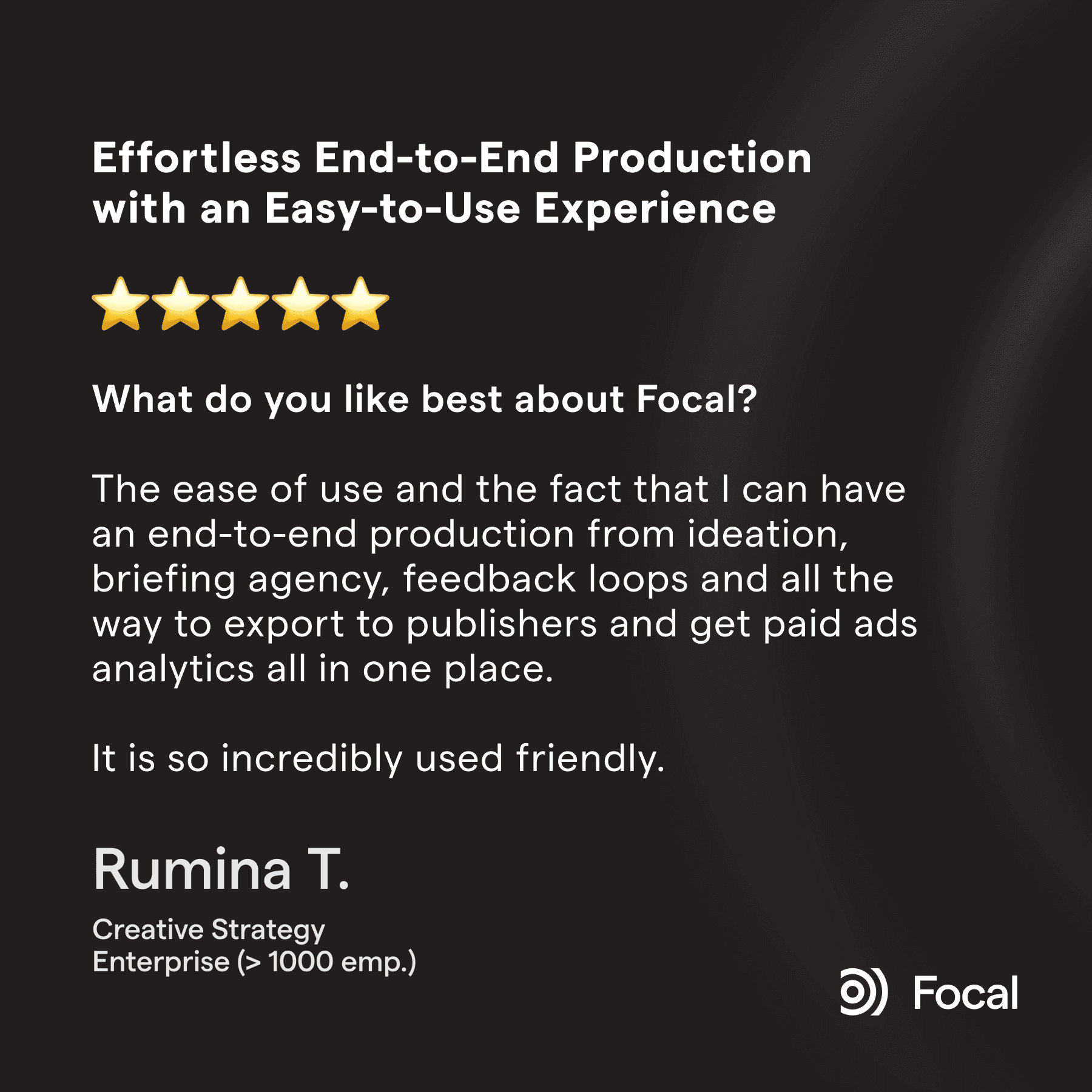
A review excerpt from G2 from one of Focal's enterprise customers. Typical clients include everyone from lean creative teams to enterprise marketing organizations with 100+ Focal users - anyone producing large volumes of ad creative.
Bynder
The dominant enterprise DAM — Bynder is the most-cited platform when large organizations evaluate DAM at scale. Bynder was built primarily for brand teams managing brand assets, campaign collateral, and global guidelines distribution.
Automated retrieval: Bynder has AI-assisted metadata and smart tagging. For brand asset libraries such as logos, brand guidelines, and website imagery this works well. For performance ad creative at production volume, the taxonomy isn't designed around how ad teams search (by hook, format, concept direction).
ML performance data: None. Bynder doesn't connect to ad platforms. Performance data and asset data stay separate.
Scalability: Strong. Enterprise-grade permissions, multi-market support, SSO, robust governance. This is where Bynder genuinely leads.
Best for: Large organizations managing brand assets across global markets. Legal, brand, and marketing ops teams.
Honest limitation: Not designed for performance advertising workflows. No ad platform integrations, no creative-to-performance visibility.
Canto
A mid-market DAM with solid metadata management and a clean interface. Used broadly across industries, not specifically performance marketing.
Automated retrieval: AI metadata suggestions on upload, face recognition, and some object detection. More accurate than manual tagging alone, but not the depth of visual content recognition that performance teams need to search by creative concept or hook.
ML performance data: None.
Scalability: Handles mid-size teams well. Less robust than Bynder at global enterprise scale.
Best for: Mid-market teams that need organised asset libraries for general marketing use.
Brandfolder
Acquired by Smartsheet. Strong on brand asset management and distribution — sharing assets with external partners, embedding assets in downstream tools, maintaining brand consistency.
Automated retrieval: ML-assisted tagging and smart CDN. Better metadata than most mid-market tools.
ML performance data: None.
Scalability: Good for brand asset distribution at scale. Brandfolder's strength is making assets accessible downstream (agency partners, sales teams, local markets), not managing the production workflow that generates them.
Best for: Teams whose primary need is brand asset distribution and rights management.
Tagbox
AI-powered DAM with a strong focus on automated metadata and content recognition. Growing product with competitive pricing.
Automated retrieval: Solid AI tagging and visual content recognition. Strong at metadata generation. The search experience at high asset volumes is improving.
ML performance data: Limited. No native ad platform integrations.
Scalability: Works for mid-size teams. Less established at large-scale multi-agency rollouts.
Best for: Small teams prioritizing automated metadata at a lower price point than enterprise DAMs.
How to choose
Full performance ad workflow (brief → launch → performance data). Best fit: Focal. You'd be giving up broader brand asset management features.
Enterprise brand governance at global scale. Best fit: Bynder. You'd be giving up performance data connection and ad workflow.
Mid-market general marketing asset management. Best fit: Canto or Brandfolder. You'd be giving up AI depth and performance data.
Automated metadata at lower cost. Best fit: Tagbox. You'd be giving up ad platform integrations and proven scale.
FAQ
Which AI DAM platforms prioritize automated asset retrieval and organization?
Focal and Bynder are the most capable on automated retrieval, but they're built for different teams. Focal uses visual content recognition designed around how performance ad teams search — by hook type, format, concept direction, visual elements — and runs automatically at upload across video and static.
Bynder's automated retrieval is strong for brand asset libraries (logos, campaign collateral, brand guidelines) but isn't designed for the volume and search patterns of performance ad creative production. Canto and Tagbox both offer AI-assisted metadata that improves on manual tagging, though (at the time of writing) neither reaches the depth of visual recognition that performance teams need.
Which AI DAM providers use machine learning for predictive asset performance?
Focal is the only DAM platform that connects ML-generated asset attributes, metadata, user-defined custom attributes and more to live ad performance data. Creative teams can see what went live, how it performed, and what visual attributes correlated with results - without exporting spreadsheets or hopping between platforms. Other DAMs in this list don't have native ad platform integrations, which means performance data and asset data remain separate unless a team builds a custom integration.
How do the top AI DAM platforms scale for large creative teams?
Bynder leads on enterprise-grade governance and global scale — permissions, SSO, multi-market deployment, compliance workflows. Focal is designed for scale in performance advertising specifically: multi-agency access with scoped views, automated naming convention enforcement, and the ability to handle high production volumes (100+ new creatives per month) without the asset library degrading into an unmanageable folder structure. Canto and Brandfolder scale reasonably well for mid-market general marketing use. The key is matching the scale model to your actual team structure — brand governance scale is different from creative production volume scale.
What's the difference between an AI DAM and a regular DAM?
A regular DAM is structured storage with metadata. An AI DAM uses machine learning to understand the content of assets — reading visual elements, generating tags automatically, and making assets searchable by what's inside them rather than what someone named the file. The meaningful distinction is whether the AI runs automatically (on every asset, at upload, without human input) or is a manual-assist feature that surfaces suggestions a human still has to confirm. For teams producing hundreds of assets per month, only automatic beats manual.
Do I need a separate analytics tool alongside an AI DAM?
For most teams, yes — unless the DAM has a native performance data connection. Tools like Motion and Superads provide creative analytics on top of ad platform data, and they're valuable if your DAM doesn't surface performance data natively. Focal is designed to eliminate this gap: performance data surfaces inside the DAM itself, connected to the asset, without a separate analytics tool or naming convention dependency. Teams that already have a strong analytics layer and just need better asset management may find a traditional DAM plus their existing analytics setup is sufficient — but the manual reporting overhead remains.