Why Legacy DAMs Fail Performance Advertising Teams
An honest breakdown of why traditional DAM platforms fall short for performance advertising teams running high-volume creative operations.
Why Legacy DAMs Don't Work for Digital Asset Management for Performance Marketing Teams
It's Monday morning. You have three agencies running, two new concepts launching this week, and 47 assets sitting in a Google Drive folder with names like `final_v3_FINAL_USE THIS_revised.mp4`. Your media buyer is messaging you asking which ones are approved. Your designer doesn't know what went live last sprint. And you're supposed to brief a new batch before Friday.
This is the reality for many performance advertisers' creative teams, and a massive tooling problem.
Most performance advertising teams are running their creative operations on tools that were never built for this kind of work, mainly because, until recently, there was no better option. The tools that claimed to solve asset management were built for brand teams and enterprise IT departments. Not for Creative Strategists producing 400 new ads a month across Meta, TikTok, YouTube, and other platforms.
That mismatch is what we're going to unpack here. And more importantly, what digital asset management for performance marketing should actually look like.
What traditional DAMs were built for
Bynder, Canto, Frontify are serious tools that were built to solve a real problem. That problem just isn't yours.
Traditional DAMs were designed around brand governance. A large organisation needs to ensure every employee, agency partner, and regional office is using the approved logo, the right product photography and the correct version of the brand guidelines. Assets don't change often, and the volume of new files per month is modest. The workflow is review, approve, distribute, done.
These tools are genuinely great at that. They have version control, access permissions, expiry dates, watermarking, and DAM taxonomy features that serve a compliance-oriented brand operation well.
But performance marketing is a different animal entirely. Your assets don't sit in a library for six months. They're produced, tested, iterated, and killed in weeks. You're not distributing one approved logo to 50 countries. You're testing 10 variations of the same concept to find the two that are worth scaling. The system that handles that needs to be built around production velocity, not governance.
This isn't a criticism of traditional DAMs. It's just a matter of fit.
What performance creative teams actually need
If you've been a Creative Strategist or UA Creative Producer for any length of time, you already recognize this list. These are the five things that make or break your workflow, and traditional DAMs weren't designed to handle these.
1. High-volume creative production and management
Performance teams don't produce 20 assets a quarter. They produce 100 to 500+ new ads a month, often working with multiple creative agencies and other partners simultaneously, running parallel sprint cycles across formats (UGC, video, statics, carousels). The workflow has to support this cadence without breaking.
Traditional DAMs were built around a slower, more controlled production cycle. When you're uploading a new batch every week from three different agencies, you need tagging, organisation, and review workflows that can keep pace automatically, not manually.
You also need assets to be easily discoverable. With large creative volumes, finding the right folder is perhaps 10% of the struggle. Finding just the right asset can be extremely difficult if you don't have the ability, for example, to search by copy inside a creative asset, a video frame, a theme, and other parameters. Filenaming gets you part of the way there, but truly intelligent search is often lacking on many of these platforms.
2. Asset naming that is actually enforced, across channels
Here's what the current workflow looks like for most teams: an asset is approved, downloaded from wherever it lives, renamed manually (if the naming convention is even followed), re-uploaded to the ad platform, and then tagged again in the ads manager.
"Every time we have a batch ready, you download it, and then you manually have to upload it to the channels. We're staring at download and upload screens."
This is the status quo as perfectly voiced by a Creative Strategist at a major DTC brand.
Every approved asset basically requires a human to touch it twice before it goes live. At 400 creatives a month, that's not a minor inefficiency but closer to a full-time job.
A DAM built for performance marketing, like Focal, has native integrations with the advertisers' essential channels. Approved assets go to Meta, TikTok, YouTube, and more directly, automatically named in the correct way, without manual uploads.
3. Performance data connected directly to assets
Most teams either don't have visibility into which creatives are performing, or they're bridging the gap with manual reporting. And manual reporting only works from the creative point of view if everyone follows naming conventions every time (which they don't).
"My designer made 100 statics for the last guy and I don't even know if it went live."
"We have no idea which creatives are actually performing until we check each platform manually."
This is a normal state of affairs for most performance teams. It results in creative decisions getting made purely on instinct, not supported by data. While instict can help find winners now and then, it rarely leads to iterations truly compounding performance. Every sprint starts without a real baseline.
What you actually need is performance data that lives next to the asset, instead of separate analytics tool, bridged by a naming convention that maybe half of your creativer output follows. For true shared understanding, you need 100% of your assets properly named, with performance connected to each asset so the Creative Strategist and media buyer are looking at the same information without any manual steps (or errors) in between.
4. Multi-agency workflow management in one place
Managing one agency isn't a big hurdle. Three is still fairly manageable. Six or more isn't rare. With each additional agency, the workload and issues tend to compound though. Every agency works in its own tools: its own Notion boards, Drive folders, Slack channel, and possible other tools. You're the one that needs to stitch it all together.
"We have Monday, Jira, and Slack and different vendors with their own Notion boards. It's not ideal."
The brief-to-submission workflow needs to accommodate external agencies without requiring them to learn a complex platform or giving them access to everything. Traditional DAMs have access controls, but they weren't designed around the specific workflow of a performance team briefing multiple creative vendors in parallel.
5. Fast brief-to-launch cycles with no tool-switching
The full creative workflow typically looks something like this: brief → production → review → feedback → revision → approval → naming → upload → live. For most teams, each step lives in a different tool:
Brief in Notion.
Production tracked in Asana or Monday.
Review and feedback in Frame.io or Slack.
Approved files in Drive or Dropbox.
Naming fixed manually.
Uploads done manually to each separate ad platform.
"We stitched together like five different tools just to get an ad out the door."
Every handoff between tools is a place where things slow down, get lost, or break. The faster you're moving — and performance teams move fast — the more painful this is.
None of these five requirements are in a legacy DAM's DNA. They're not what those tools were designed to do.
Why do general creative ops platforms fall short for performance creative teams?
Some platforms have recognised the gap and moved in this direction. They've added workflow features on top of asset storage, or layered on performance analytics modules. It's progress, but still doesn't close the gap.
Here are the most common limitations in these "general creative ops" tools:
AI-powered tagging is locked behind expensive enterprise tiers: This is a real friction point. One team we spoke with found the smart tagging they needed was gated behind a plan upgrade that ran to tens of thousands per year. The result: they were still tagging manually, which is the thing they most wanted to stop doing. Traditional DAMs don't have a performance marketing team's point of view either, so even if there is some kind of autotagging, the tags themselves rarely contain information that performance creative teams find most relevant.
Performance data is an add-on, not native. When creative analytics live in a separate module or a third-party integration, you're back to the same problem: your designer doesn't have visibility, your Creative Strategist is switching tools, and the loop between what was produced and what performed isn't actually closed.
Channel integrations exist, but they're not the core. When direct publishing to Meta, TikTok or YouTube is an add-on rather than a fundamental part of how the platform works, it tends to be limited, brittle, not fully automated, or dependent on third-party connectors that require maintenance.
The workflow logic maps to brand or agency production, not performance sprints. The way a performance team works — short cycles, high volume, multiple external agencies, fast iteration — is different from how a brand team or a traditional creative agency operates. Tools built for the latter don't naturally support the former.
What does a DAM built for performance advertising actually look like?
Go back to the five requirements. Here's what meeting each of them looks like day-to-day.
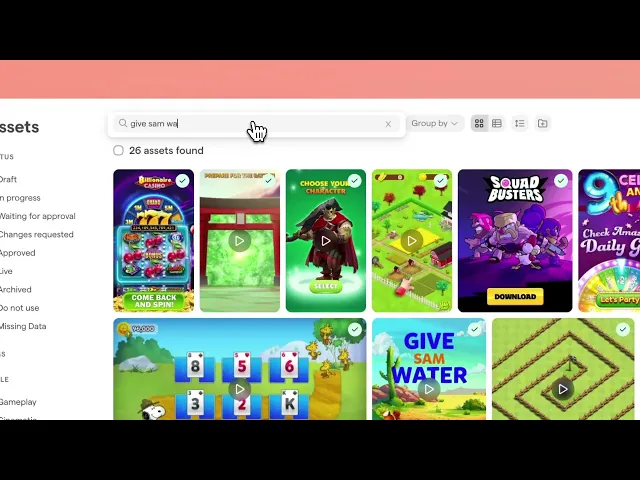
1. High-volume creative production and management: Assets are automatically tagged when they're uploaded by visual content, format, hook type, talent, product shown, or other parameters the user wants to define. No one spends an hour tagging a batch. The library stays searchable even at 5,000, 10,000, or 50,000 assets and beyond. You can find whatever you need using natural, intelligent search: the statics with a red background, or that video that featured the product with specific copy at the two-second mark, without opening a single file manually.
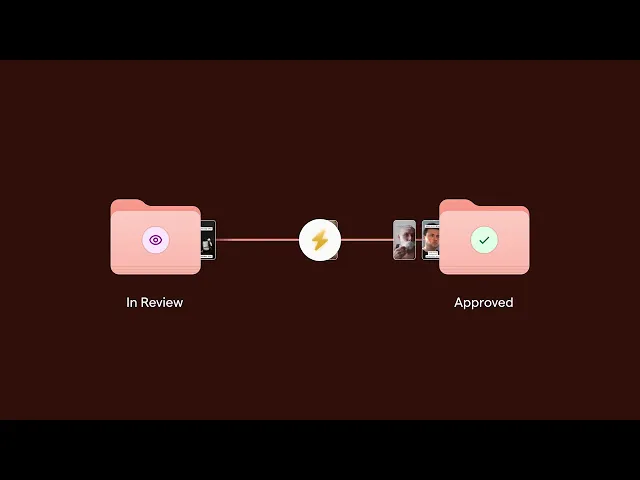
2. Automated asset naming across channels: An asset gets approved. It goes to Meta, TikTok and YouTube directly from the platform, with naming conventions applied automatically. The media buyer doesn't wait for a file download and the Creative Strategist doesn't need to rename anything.
3. Performance data connected to assets: Every asset in the library has its performance data attached — impressions, spend, ROAS, the creative brief it came from. Your designer can see what went live. Your Creative Strategist can see what's performing without leaving the asset library. Iterations start from actual data, not from "I think the hook with the testimonial worked better."
4. Multi-agency workflow management: Agencies are briefed directly in the platform. They submit assets to their designated workspace. They receive feedback on the asset itself, in the case of videos even down to the frame-by-frame level, and not in a Slack thread. The Creative Strategist has a single view of what all agencies, creators or other partners are producing, where every asset is in the review cycle, and what's approved and ready.
5. Brief-to-launch with no tool-switching: With modern digital asset management built for performance advertising, everything happens in one place, considerably speeding up the time from brief to live ad (we've seen throughput speed improvements north of 75%). The brief lives in the platform, the production is tracked there, review and frame-by-frame feedback happen on the asset, approval triggers the naming convention and the channel integration, the workflow runs in one place end to end.
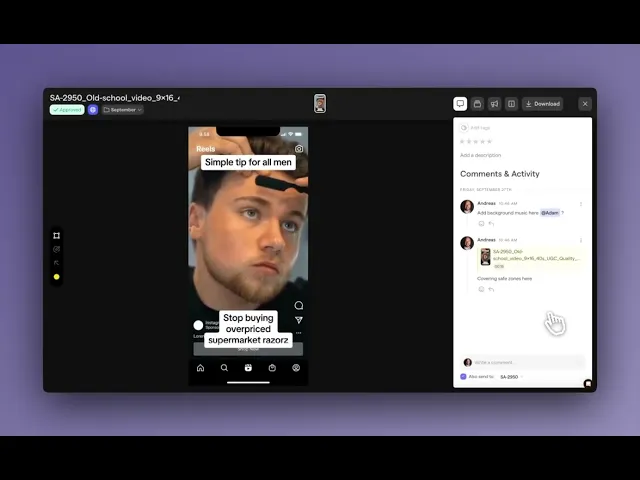
Focal meets all of these requirements and more. To see how different DAM platforms compare on these dimensions, see the complete comparison of DAM platforms for marketing teams.
What does a performance DAM look like in practice?
So what do performance DAMs like Focal look like?
Peter McLaughlin, UA Creative Producer at Supercell, one of the world's largest mobile gaming companies describes the benefits of using this kind of platform well:
"Focal has allowed me to double my creative output and dramatically sped up our creative approvals and management."
Read the Supercell case study.
Supercell's team is producing at a scale most companies never reach, and the result was 2x creative output with 50% less time spent on review and approvals. This allows them to test more concepts, find more winners, and perform better in a market with ever-increasing competition.
Oisin Walsh, UA Lead at Sybo, the studio behind Subway Surfers:
"Creative Boards and Automations transformed how we manage UA creatives. It's easy to get started and Focal has streamlined our workflow from start to finish."
Two different types of teams arrived at the same conclusion. The problem wasn't their discipline or their people. They simply needed to adopt new tools that more closely matched the demands of their work.
The advantages of a performance DAM grow over time
Admin hours saved are real, and they're significant. But there's another effect that becomes orders of magnitude bigger over time.
Teams that can connect performance data to assets, tag everything automatically, close the loop between what was produced and what performed — build a library of winners that gets smarter every sprint. Every iteration starts from a stronger baseline. They know which hooks work for which audience. They know which visual formats hold attention. They know what to brief next, because they have data, not just assumptions.
Teams that stay on legacy stacks with everything jumbled in Drive, naming conventions that aren't correct, no idea which creatives are actually performing, start from scratch every quarter, relying to a large degree on luck to keep performing over time. They're running on instinct when the team next to them is running on a year of compounding creative intelligence.
If you're at the point where your current stack is costing you time you should be spending on creative strategy, it's worth seeing what the alternative looks like. Book a demo of Focal, bring your actual creative library and we'll show you the difference.