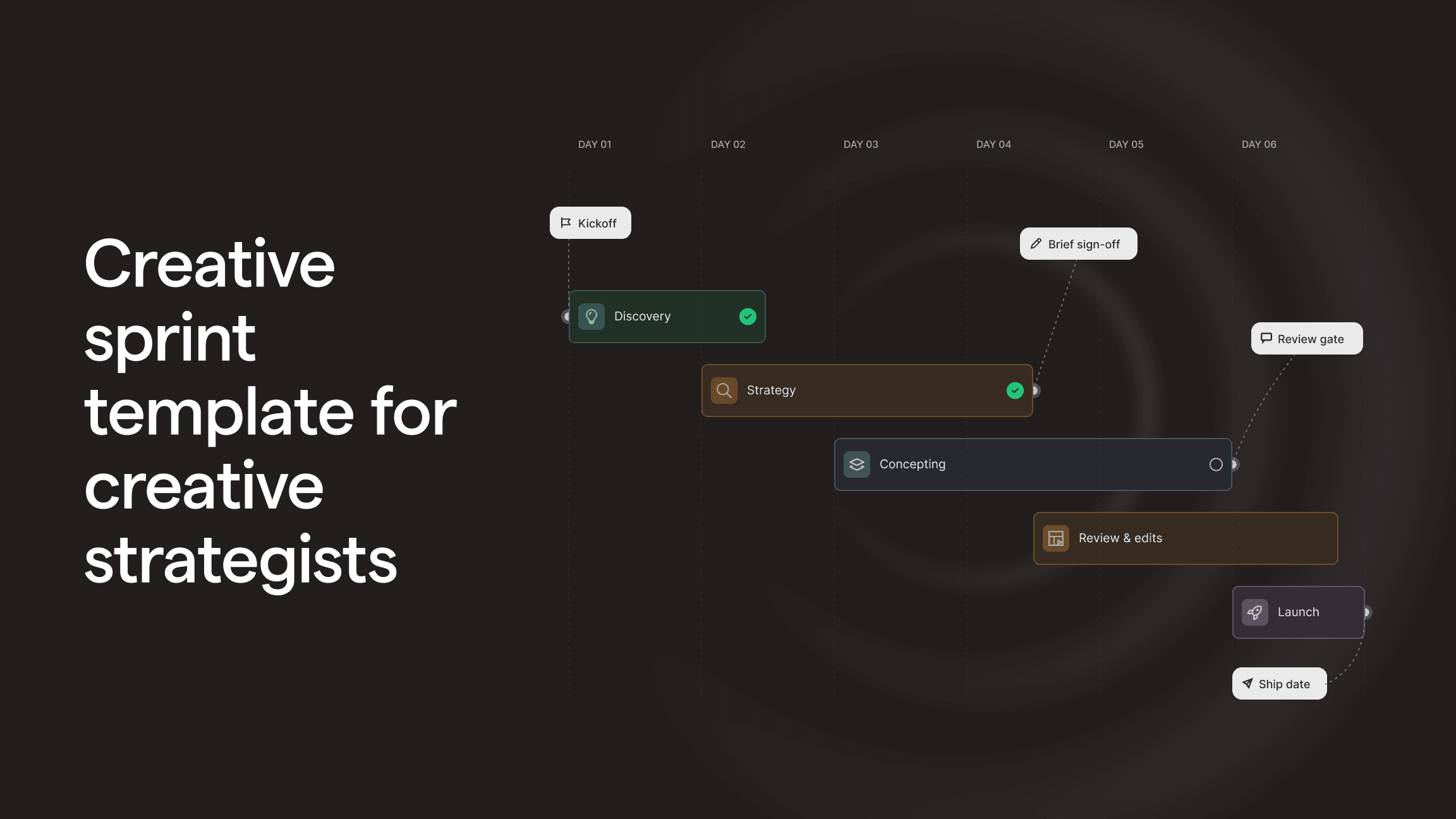
Tips for working with creative agencies: a performance guide
Working with creative agencies as a performance team is hard. Here's what breaks at scale — and what the right workflow looks like.
[Originally published in September 2023, this post has been updated on April 30, 2026]
It's Wednesday afternoon. Your media buyer just messaged asking which creatives are approved from the last batch. Agency A delivered their files via WeTransfer yesterday, with a different naming convention than Agency B, who dropped a Dropbox link on Monday with 37 files and no folder structure. Agency C is still waiting on feedback from two weeks ago that got buried in a Slack thread. You've briefed four new concepts this sprint. You have no idea where three of them are.
This is what working with creative agencies for performance advertising actually looks like at scale. Not the version where you align on goals, trust their expertise, and watch great creative flow into the ad platforms. The version where managing multiple creative agencies, each with their own tools, naming conventions, and delivery methods, eats the hours that should be going into creative strategy.
Complexity compounds – why working with creative agencies at scale is harder than it looks
The creative quality problem, finding agencies that produce good work for your brand, is real but usually solvable. The harder problem is operational, and compounds with every agency you add.
One agency is manageable. You establish a working rhythm: files come in, you review them, you upload to Meta. At 50 creatives a month from a single partner, the status quo stack holds.
Two agencies starts to strain it. Now you have two separate delivery methods, two sets of naming conventions, and feedback scattered across two different Slack channels or other review tools. You start losing track of what's been reviewed, what's been approved, and what's in the next batch.
Three or more, and the issues start multiplying fast. One creative strategist we interviewed a while back said it well: "We have Monday, Jira, and Slack and different vendors with their own Notion boards. It's not ideal."
The chaos isn't because your team lacks discipline, it's simply because there haven't been great ways to standardize the process. Every agency brings its own workflow into your workflow. Without a system built to handle that, the person managing the agencies becomes the system, manually stitching together what the tools don't.
Where working with creative agencies actually breaks down, from brief-to-delivery
Working with creative agencies for performance advertising means running a continuous production loop across external partners who don't share your tools, your conventions, or your context. Here's where it breaks at each stage.
1. Briefing without a single source of truth
Briefs go out via Slack or email. Updates get communicated verbally on a call. Someone asks a clarifying question via DM that changes scope. By the time production starts, there are at least two versions of the brief in circulation, and neither is clearly the current one.
When creative comes back not quite right – wrong hook, wrong format, wrong copy angle – there's no record of what was actually asked for. You're in a debate with the agency about what was agreed in a Slack message from three weeks ago.
Multiply this across four agencies simultaneously and the problem is obvious. There's no central place where "current brief" means something definitive.
2. Asset delivery chaos
Every agency delivers differently: WeTransfer links, Dropbox folders, Google Drive shares, email attachments or other formats. Some name files with your naming convention (most don't). Some include version numbers.
You receive 40 files and spend the first hour renaming them, sorting them into the right folders, and figuring out which version of `concept_UGC_v2_FINAL_revised.mp4` is the one you should actually be reviewing.
This isn't a one-time problem. It happens every sprint with every agency. And every file that arrives with the wrong name is a file that either gets renamed manually or lives in the library, permanently unsearchable.
3. Feedback in the wrong place
Video feedback happens in Slack threads: "at about 15 seconds the transition feels off." What "about 15 seconds" means depends on who's reading it. The agency interprets it one way. You meant another. The revised version comes back with a different problem. It also adds inefficiency and a surprising amount of time is lost when comments aren't precise and editors need to scrub footage to find the right things.
For statics, it's a comment in a Google Slides deck, or a screenshot with arrows drawn on it. Approval is a Slack thumbs-up that gets buried by the next message.
No frame-level precision or version history. No audit trail showing which version was approved and when. When an asset goes live and turns out not to be the right version, there's no record to check.
4. No central visibility across agencies
To know what's currently in production across all your agencies, you send messages to four different people and wait for replies. There's no live view. No status board. No way to see at a glance what's approved and ready to launch, what's in review, what's been sent back for revisions, and what hasn't been touched.
When you're working with creative agencies at volume — 200, 300, 400+ new creatives a month — this absence of visibility means every sprint feels like recovering from the last one rather than building on it.
5. Manual handoff to channels
An asset gets approved. It lives in a Drive folder. To get it live, someone downloads it, renames it to match the ad platform's naming convention (if they remember), and manually uploads it to Meta, TikTok, and YouTube.
At 100 creatives a month from two agencies, this takes a few hours per sprint. At 400 creatives from four agencies, it's a near-full-time job that sits on top of everything else the media buyer is doing.
What working with multiple creative agencies looks like when the workflow is right
If you have proper workflows and tools in place, the picture is starkly different. You still deal with the same creative volume and the same number of agencies, but the process is much more efficient, scalable, and allows you to build on previous learnings, ultimately running better performing advertising.
Briefs: Every agency gets briefed in the same platform. The brief is a living document. When it updates or a comment is added, every stakeholder sees it. There's no ambiguity about what was asked.
Creative asset management: Assets submit to one "intake point", regardless of which agency produced them. Files arrive and get tagged automatically, not just based on filename but on what's actually in them: format, visual elements, hook type, talent and more. The library stays searchable even at 10,000+ creatives, because the system maintains the taxonomy, not humans.
Feedback and reviews: Feedback happens directly on the asset. Comments on videos are marked frame-by-frame, so nobody needs to scrub footage to find what needs editing. Version history is automatic. Approval status is tracked across every creative in the sprint visible to the whole team without anyone sending a Slack message to find out.
Ad platform uploads: When a batch is approved, assets go to Meta, TikTok and YouTube directly. Naming conventions are enforced automatically before anything leaves the platform. The media buyer doesn't need to manually download or name a single file.
Reporting on results: Performance data connects back to the asset in the library. The Creative Strategist and the designer both see what went live and what performed, from the same place they manage production. The next brief starts from that data.
"Focal has allowed me to double my creative output and dramatically sped up our creative approvals and management."
Peter McLaughlin, UA Creative Producer at Supercell
-> Read the Supercell case study
Choosing the right tools for creative agency collaboration
Most performance creative teams are operating with a fragmented tool stack with usually around 3-6 different tools.
At low volume, this stitched-together stack is fine. Here's an example setup:
Google Drive for storage.
Slack for feedback.
Frame.io or similar tool for video review.
Asana, ClickUp or Monday for production tracking.
Each tool solves its part of the problem. However, not every partner you work with uses the same exact stack and getting all of them to work directly inside your tools and views might not always be possible.
At scale, the failure mode isn't any one tool, it's the handoffs between them. Every transition between tools is a place where information gets lost, naming conventions break, and the Creative Strategist needs to manually start combing through platforms, files and conversions to stitch things together.
A video review platform doesn't track deliverables, manage naming conventions, or push approved assets to Meta.
Asana and Monday solve production tracking. They don't have proper visual asset storage, automated tagging, or channel integrations.
Google Drive stores files. It doesn't track review state, support proper commenting directly on the asset, enforce naming conventions or connect performance data to the files it holds.
A creative operations platform built for performance advertising is the right approach to creative agency management for performance marketing. It covers the full creative agency workflow in one place: briefing, production tracking, asset review, AI-powered tagging, automated naming, direct channel delivery, and performance data connected to every asset. The workflow doesn't break between tools because there's only one.
Best practices for working with creative agencies
The right practices aren't about communication frameworks or trust. They're operational specifics that make the difference between a workflow that holds at scale and one that doesn't.
Standardize brief delivery
A single brief should be delivered in the same format, on the same platform to everyone working based off it. If one agency gets a Notion doc and another gets a Slack message, you've already created two sources of truth.
Centralize asset intake
Set up one place for every agency to submit finished work. Not four Dropbox links. Not WeTransfer with expiry dates. One intake point that you control, with naming and organization applied automatically on arrival.
Give feedback on the asset, not in Slack
Provide structured feedback on all assets, and ideally frame-level comments on video and interactive formats such as playable ads. Every comment should be tied to a specific file and version, not to a message thread that scrolls away.
Don't rely on agencies to follow your naming conventions
Trying to enforce asset naming for agencies rarely works when asset naming is manual. This is simply because agencies have their own naming logic for their own workflow. Naming enforcement has to happen on your end, at the point of intake, automatically.
Connect performance back to the brief
The agencies producing your creatives should know what's working. Not via a spreadsheet someone built and shared once. It needs to be a live connection between the asset and its performance data, such as a dashboard or a tag that clearly identifies winners. This is what makes creative partnerships genuinely strategic over time.
Give agencies access without giving them everything
Agencies should be able to see their briefs, submit their work, and receive feedback without seeing your full library, your other vendors, or your performance data. A guest model that isolates their view keeps the workflow functional without exposing things they shouldn't see.
In conclusion
The teams that manage creative agencies well at scale aren't necessarily doing anything more disciplined than the teams that don't. They just have infrastructure that makes the right way of working easier.
The Creative Strategist who's spending hours per sprint renaming files, chasing approvals in Slack, and uploading manually to Meta has those same hours back when the workflow is right. They spend them on briefs, on strategy, on reviewing performance. That's what compounds over time.
If you're managing multiple agencies, or would like to grow your creative production volumes efficiently, get in touch and let's discuss how Focal can help.