Creative strategy overview: DTC supplement brands
An analysis of 3,093 tagged creatives (1,719 unique ads) across 37 DTC supplement brands — here's what's actually working in the space in 2026.

1. Executive summary
About the data:This report analyzes 3093 ad creatives across 1719 distinct adds pulled from 37 DTC supplement/wellness brands in the beginning of July, 2026.
How to interpret this report: Since creatives came from a swipe file app, there is no performance data attached to these ads. It is also good to note that the maximum amount of individual ads pulled per brand was 50, and some brands run more active ads than that at a time. This report serves best as a general trend guideline, and it's most meaningful when looked at trends in the aggregate across brands, rather than analyzing an individual brand only.
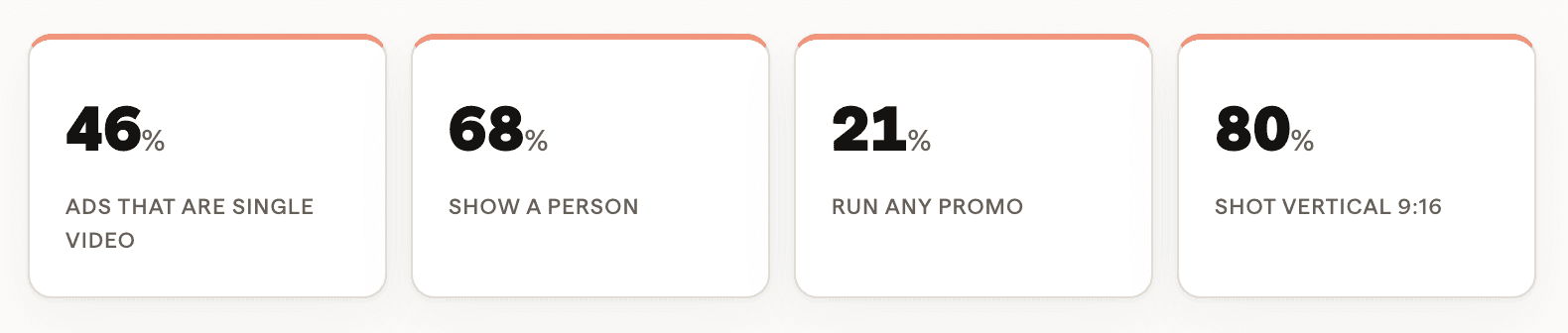
Video leads, but not by a landslide. 46% of ads are single video, 33% are carousel or dynamic creative (mix of images and video), 22% are single image statics. Carousel/DCO is doing more work in this category than the "video wins" conventional wisdom suggests.
A person shows up in 68% of ads. Product-only shots are the minority (30%), and when a person is on screen, women outnumber men more than 3 to 1 (66% vs 20%, with 13% multi-person).
Most brands aren't running a promo at all. 68% of ads carry no discount, code, or free-gift offer anywhere in the ad. When a promo does appear, it's almost always a straight percentage discount instead of a flat amount.
Nine in ten shots are vertical. 80% of assets are shot 9:16-ish. Square is a distant second (19%), horizontal is nearly extinct (1%).
Muscle growth, general nutrition, and hydration are the three value props doing the heavy lifting, together accounting for over 65% of value props.
Curiosity gap and FOMO are the two most-used hook mechanics by a wide margin, ahead of problem-solution framing and social proof.
Explicit credibility signals are rare. Only about 2% of ads reference something concrete like a clinical study, doctor endorsement, or certification once you strip out generic "this creator reads as an expert" language. There are multiple possible interpretations: either that explicit credibility is ineffective in this ad category, explicit medical proof doesn't exist yet, and/or that there is a considerable untapped opportunity here.
2. Introduction
Supplement/wellness is one of the most competitive and rapidly-growing categories of direct-to-consumer (DTC) commerce. There are dozens of brands with considerable spend on Meta Ads, with large numbers of active ads.
Standing out can be challenging, and knowing the latest creative trends can help you win by creating more material that is similar to what has been working for competitors lately – or material that stands out from them. That is why we created this report series where we analyze a large number of recent, live ad creatives across different brands operating in a specific industry.
We hope you find this report useful! Feel free to share it to anyone who would find the contents helpful.
If you're interested in seeing how Focal can help your brand create more winning ads, get in touch.
3. Methodology & scope
Analysis was conducted by pulling ad creatives via a swipe file app, and then uploading them into Focal where our AI was used to analyze every asset by multiple parameters: formats, themes, hooks, actual visual contents in the ad creative, text on screen, and even scene-by-scene content in videos.
Sample: 37 brands were included in the analysis, capped at 50 live ads each. These 37 brands returned a total of 3,093 creative assets across 1,719 distinct ads (multi-card carousel/DCO ads collapse to one ad; each card is still analyzed individually for content-level tags) that were live in the beginning of July 2026.
Note on data limitations: we have no spend, CTR, or conversion data here as that lives in each brand's own ad account, not in swipe files. This report serves best as a general trend guideline and for spotting potential opportunities. Data should be looked at mostly in the aggregate across brands, rather than analyzing an individual brand only.
4. Category snapshot
Metric | Value |
|---|---|
Brands analyzed | 37 |
Distinct ads | 1,719 |
Analyzed assets (incl. carousel cards) | 3,093 |
Format mix | Single video 46%, carousel/DCO (video and/or static) 33%, Single static 22% |
Ads with a person present | 68% |
Ads with any promo | 21% |
Vertical (9:16-ish) assets | 80% |
Assets with a hook description tagged | 1,084 (35%) |
Assets referencing a concrete credibility signal | ~2% |
5. Dimension-by-dimension analysis
5.1 Value propositions & messaging themes: muscle growth leads
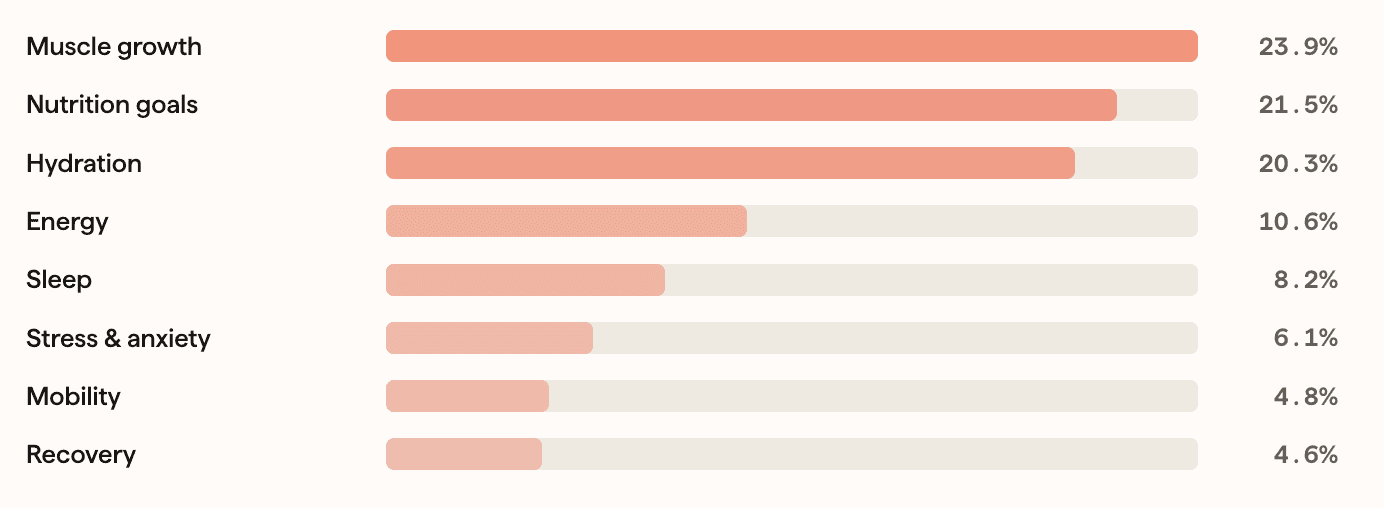
Three value props — muscle growth (23.9%), general nutrition goals (21.5%), and hydration (20.3%) — account for two-thirds of every value prop tag applied. That's a narrower spread than the 37-brand roster might suggest: sports nutrition and hydration brands are simply more numerous and more prolific in this sample (Arrae, Beam, Timeline, Novomins, and the protein-powder brands alone drive a lot of the muscle-growth and nutrition-goals volume).
Sleep (8.2%), stress/anxiety (6.1%), mobility (4.8%), and recovery (4.6%) are real but secondary angles, mostly carried by a handful of specialist brands (Bare Biology and Designs for Health lean sleep; Rho Nutrition and Hairburst lean stress/anxiety; BodyBio leans recovery).
Facebook Ad Library examples:
5.2 Hooks & opening patterns: curiosity gap dominates
1,084 assets (all video, since hooks are a video/audio-opening concept) were analyzed for hooks. This included the psychological mechanism the ad's opening line or scene relies on.
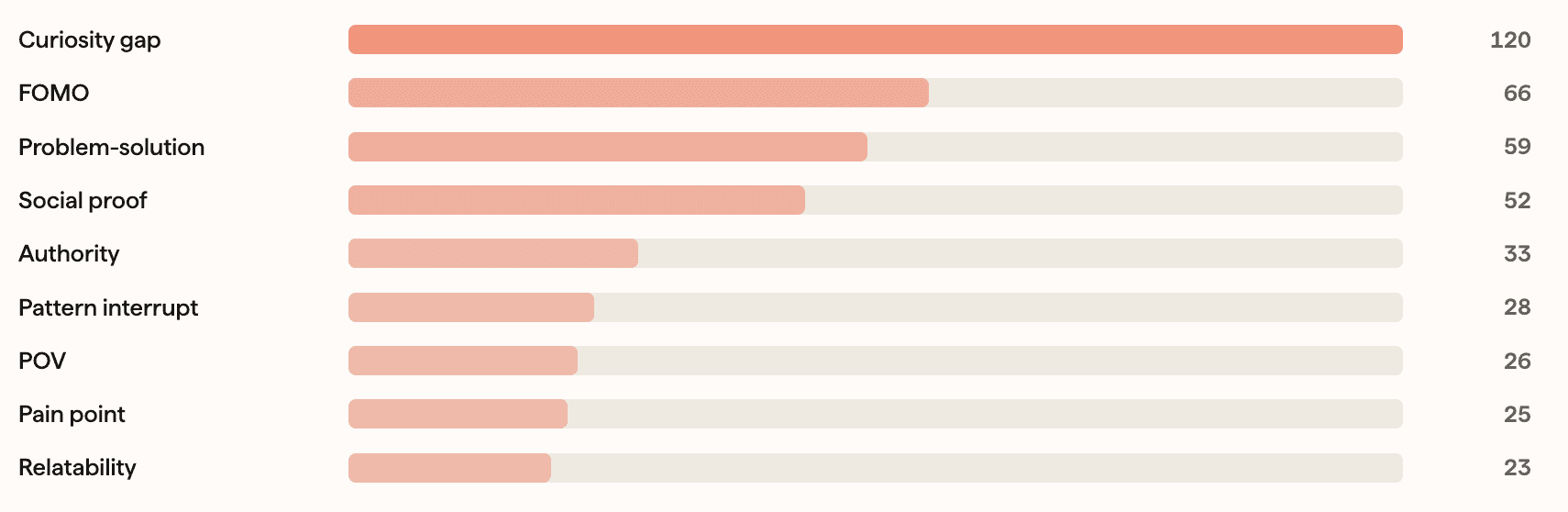
(Counts aren't mutually exclusive — a single hook description often names two or three techniques at once, e.g. "curiosity gap and social proof." For definitions of the hook types, see the Appendix)
Curiosity gap (120 counts) alone shows up in over 1 in 10 hook descriptions, well ahead of anything else. The category's opening lines lean heavily on withholding information ("the craziest thing about...", "what nobody tells you about...") rather than leading with the benefit outright.
FOMO (66 counts) and problem-solution framing (59) are a clear second tier, and straight authority/expert-framing hooks (33) are less common than the other four combined.
Facebook ad library examples:
5.3 Promotions & offer mechanics: most brands do not heavily lean on price or discounts
At the individual-asset level (does this specific image/frame carry a promo):
Promo type | Share of tagged assets |
|---|---|
No promo | 75.2% |
Discount % | 16.7% |
Promo code | 4.6% |
Free product | 3.4% |
Free shipping | 0.2% |
At the ad level (does *any* card in a multi-card ad carry a promo — a more accurate read on whether the ad itself is a promo push):
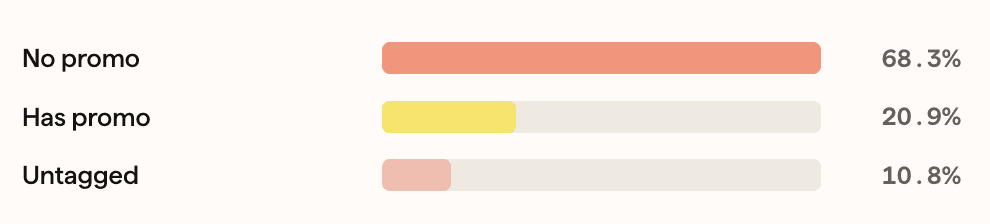
Roughly 7 in 10 ads in this category (68.3%) sell on mechanism or value, not price. When brands do run a promo (20.9%), a plain percentage discount is by far the default mechanic. Promo codes, free product, and free shipping are minor by comparison.
Promo usage varies enormously by brand: Vitabiotics (78% of ads), Beam (88%), Seed Health (67%), and AG1 (63%) lean hard into discounting, while Arrae, Bare Biology, BodyBio, and Naked Nutrition ran zero promo ads in this sample.
5.4 Talent & people presence: women lead 3 to 1
Of assets where a person appears (i.e. excluding product-only shots), the ratio of male vs. female was as follows.
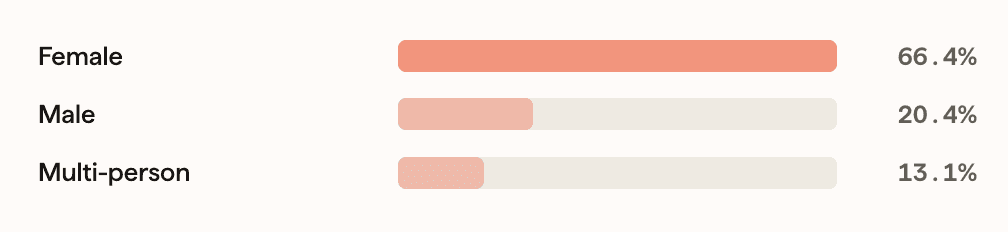
Women (66.4%) outnumber men (20.4%) by more than 3 to 1 as the on-screen talent in this category, even accounting for brands like Drink LMNT, IM8 Health, Liquid I.V., and Rho Nutrition that skew male.
Multi-person/testimonial-montage format (13.1%) is a meaningful third lane rather than a rounding error, Bulk, Gutology and Novomins Nutrition all lead with multi-person casts.
Facebook Ad Library example of a multi-person cast from (BodyBio)
5.5 People vs. product-only shots: people matter

This varies more by brand than almost any other dimension in the dataset.
At one extreme, O Positiv Health, Cymbiotika, and Vivo Life show a person in essentially every ad (95-100%).
At the other, Seed Health (28%), Hiya (32%), Promix Nutrition (32%), and Designs for Health (36%) lean heavily on product-only or packaging-forward creative.
Category-wide, showing a person is the default (68.4%), but a meaningful minority of brands, mostly in the gut-health and clinical-supplement products, are running a product-first visual strategy instead.
Facebook Ad Library examples:
5.6 Format & production mix: video leads, but less than expected
At the ad-level (cards collapsed to one ad), single video dominates, but less than expected.

Methodology note: Carousel/DCO 32.5% is a mix of manually-built carousels and Dynamic Creative (DCO) ads, which auto-assemble multiple product images and look identical from the file count alone.
Video (46.1%) is the plurality but not the majority. Carousel and/or dynamic creative is a genuinely large share of the category (32.5%), not a niche format. Brands like AG1 (80% carousel), Novomins Nutrition (80%), Beam (74%), and Timeline (74%) lead with it.
On the other end, Vivo Life (98% video), Elavate Superfoods (96%), Goli Nutrition (94%), and Drink LMNT (84%) are almost entirely video-first.
Pure static/single-image (21.5%) is most common at Promix Nutrition (80%), Rho Nutrition (82%), and Vitabiotics (78%) — mostly the more clinical/pharmacy-adjacent brands.
5.7 Aspect ratio & production style: 9:16 reigns (as expected)
Aspect ratio bucket | Percentage share |
|---|---|
Vertical (9:16-ish) | 79.8% |
Square (1:1-ish) | 18.7% |
Horizontal | 1.2% |
Vertical is the overwhelming default, consistent with a Reels/Stories-first placement strategy across the category. Square format persists mainly inside carousel/DCO card sets rather than as a standalone choice.
5.8 Proof & credibility signals: rarely present - potential opportunity?
When we analyzed the creatives for the use of credibility language, only 127 of 3,093 assets (4.1%) hit any of the keywords checked (clinical, doctor, certified, study, third-party tested, science-backed, research, etc.).
Of those hits, 87 are driven by the word "expert" – which, on inspection, is mostly the on-screen talent being interpreted as an authority/expert *persona*, not the ad citing a real credential. Stripping that out, only about 2% of assets (62 of 3,093) reference something concretely verifiable: a named clinical claim, an actual doctor/dermatologist mention, a certification, or cited research. For a category built on health claims, that's a strikingly low rate of ads doing the work to back them up on-screen. Most creative here sells on hook and value prop, not proof.
This could be interpreted in several ways, for example:
Advertisers might avoid using this type of creative and wording if there are legal restrictions on usage (and Meta also places restrictions on what it interprets as medical advertising).
Explicit credibility is currently not an effective promotion method in this ad category
Explicit scientific proof doesn't exist (at least yet)
Unless this is a matter of efficacy in ads, there is a clear opportunity here. Brands that are able to produce stronger credibility signals and scientific proof, could potentially stand out from competitors quite easily given the low level of these claims at the moment.
Facebook Ad Library example:
Science-backed claim citing named studies (Bare Biology) — this is one of the rare ~2%.
6. Cross-brand comparison matrix
⚠️ = fewer than 10 ads in sample, read with caution.
Brand | N ads | Dominant format | Promo rate | Person present | Dominant gender | Dominant value prop |
|---|---|---|---|---|---|---|
AG1 | 50 | Carousel/DCO 80% | 62.7% | 43.0% | Female | Nutrition goals |
AdvoCare ⚠️ | 3 | Single image 67% | 0.0% | 3.8% | Female | Energy |
Arrae | 50 | Single video 66% | 0.0% | 87.1% | Female | Muscle growth |
Bare Biology | 47 | Single image 43% | 0.0% | 98.6% | Female | Sleep |
Beam | 50 | Carousel/DCO 74% | 88.0% | 70.5% | Female | Nutrition goals |
BodyBio | 50 | Single video 82% | 0.0% | 94.4% | Female | Recovery |
Bulk | 40 | Single video 42% | 40.0% | 53.7% | Multi | Muscle growth |
Cymbiotika ⚠️ | 3 | Single image 67% | 0.0% | 100.0% | Female | Recovery |
Designs for Health | 47 | Carousel/DCO 60% | 0.0% | 35.5% | Female | Sleep |
Drink LMNT | 50 | Single video 84% | 0.0% | 93.8% | Male | Hydration |
Elavate Superfoods | 50 | Single video 96% | 6.0% | 98.1% | Female | Mobility |
Freaks of Nature | 49 | Carousel/DCO 51% | 10.2% | 55.7% | Male | Hydration |
Goli Nutrition | 48 | Single video 94% | 54.2% | 96.0% | Female | Stress & anxiety |
Gutology | 50 | Single video 74% | 6.0% | 68.4% | Multi | (untagged) |
Hairburst | 50 | Single video 52% | 14.0% | 80.0% | Female | Stress & anxiety |
Hiya | 50 | Single video 45% | 37.3% | 31.9% | Female | Nutrition goals |
IM8 Health | 50 | Carousel/DCO 78% | 8.0% | 95.6% | Male | Nutrition goals |
Instant Hydration | 50 | Single video 72% | 40.0% | 88.9% | Female | Hydration |
Liquid I.V. | 50 | Single video 48% | 10.0% | 73.9% | Male | Hydration |
MaryRuth's | 50 | Single video 61% | 27.5% | 95.7% | Female | Nutrition goals |
Momentous | 50 | Carousel/DCO 39% | 15.7% | 48.5% | Male | Muscle growth |
Myprotein | 50 | Single video 63% | 3.9% | 54.7% | Male | Muscle growth |
Naked Nutrition | 50 | Single video 64% | 0.0% | 58.3% | Female | Muscle growth |
Needed | 50 | Single image 44% | 10.0% | 97.1% | Female | Nutrition goals |
Novomins Nutrition | 50 | Carousel/DCO 80% | 2.0% | 78.9% | Multi | Sleep |
Nutrafol | 50 | Carousel/DCO 50% | 24.0% | 89.0% | Female | (untagged) |
Nutrition Geeks | 50 | Single video 43% | 3.9% | 64.4% | Female | Sleep |
O Positiv Health | 50 | Single image 40% | 6.0% | 100.0% | Female | Muscle growth |
Perelel | 50 | Single video 52% | 14.0% | 98.9% | Female | Nutrition goals |
Promix Nutrition | 50 | Single image 80% | 32.0% | 32.0% | Female | Hydration |
Rho Nutrition | 50 | Single image 82% | 8.0% | 56.6% | Male | Stress & anxiety |
Seed Health | 50 | Carousel/DCO 67% | 66.7% | 27.8% | Male | (untagged) |
Symprove ⚠️ | 23 | Single video 39% | 21.7% | 61.0% | Female | (untagged) |
Thorne | 50 | Single video 46% | 4.0% | 65.7% | Female | Energy |
Timeline | 50 | Carousel/DCO 74% | 40.0% | 49.3% | Female | Muscle growth |
Vitabiotics | 50 | Single image 78% | 78.4% | 40.0% | Female | Nutrition goals |
Vivo Life | 50 | Single video 98% | 2.0% | 100.0% | Female | Energy |
*"Carousel/DCO" in this table means "more than one creative file per ad" — see the methodology note in §5.6 for why that includes Dynamic Creative (DCO) ads alongside true manually-built carousels.*
7. Summary of identified patterns and opportunities
Saturated creative angles:
Vertical video/carousel/dynamic creative with a female talent, shot casual or sport, opening on a curiosity-gap or FOMO hook, selling muscle growth/nutrition/hydration with no promo attached — that combination alone describes a large share of the category's creative.
Curiosity-gap hooks are close to a default opener across the video-heavy brands.
Less common, worth noting:
Concrete, verifiable proof (real clinical citations, named studies, dermatologist/doctor mentions) is rare — most brands lean on hook and value prop rather than substantiation, even in a category where health claims are the whole pitch.
Multi-person/testimonial-montage format (13% of talent-present ads) is a distinct lane most brands aren't using — it's concentrated in a handful of brands rather than spread across the category.
Male-led talent is a minority everywhere except a specific cluster (hydration/electrolyte and men's-skewing brands: Drink LMNT, IM8 Health, Liquid I.V., Freaks of Nature, Rho Nutrition, Myprotein).
Product-only, no-talent creative is a deliberate minority strategy at a few brands (Seed Health, Hiya, Promix Nutrition, Designs for Health) rather than an accident. It's worth asking whether that's a considered choice for their category (gut health, kids' vitamins, clinical positioning) or an untapped format for brands currently all-in on talent.
Conclusion
We hope you found this report useful! If you want to improve your creative work by speeding up creative velocity, improving production management, analyzing your creative production more deeply and connecting it with ad performance data, or just knowing what has worked and what to brief next, you can book a call with the Focal team here.
Appendix
Limitations
Snapshot of active Meta ads only, pulled via a swipe file app in early July 2026. No TikTok, YouTube, or paused/historical creative.
No spend, CTR, or conversion data.
Two included brands (Cymbiotika, AdvoCare) have samples too small (3 ads each) for brand-level generalization.
1.9% of assets were untagged.
Hook technique definitions
Plain-language definitions for the hook mechanics.
Curiosity gap: Opens by hinting at information without revealing it yet ("the craziest thing about creatine..."), so the viewer keeps watching to find out what it is.
Fear of missing out (FOMO): Frames the product or offer as something you'll regret not acting on, usually tied to a deadline, limited stock, or what everyone else is already doing.
Problem-solution: States a specific problem the viewer likely has, then positions the product as the fix.
Social proof: Leans on other people's experience or approval — reviews, testimonials, "X million sold," or a visible crowd of users.
Authority: Uses a credentialed, famous, or expert-presenting person to lend credibility, whether or not a real credential is cited.
Pattern interrupt: Opens with something visually or verbally unexpected that breaks the scroll — an odd setting, a jump cut, a strange opening line — purely to stop the thumb.
POV: Shoots or writes the ad from the viewer's own point of view ("POV: you just found out..."), a format borrowed from short-form social video.
Pain point: Names a specific frustration or discomfort the audience feels, without necessarily offering the solution in the same breath.
Relatability: Leans on a shared, everyday experience the viewer recognizes in themselves, building trust through familiarity rather than a claim.
Benefit-driven: Leads directly with the payoff of using the product — energy, better sleep, muscle gain — rather than a story or a problem.
Secret / secret knowledge: Frames the content as insider information the audience wouldn't otherwise know, implying exclusivity of knowledge rather than of access.
Exclusivity: Implies the offer or product is only available to a limited group, waitlist, or subscriber base.
Health anxiety: Triggers concern about a health risk or consequence to create urgency around a solution.
Hidden danger: Warns about a risk the viewer likely doesn't know about (an ingredient, a habit, a contaminant), then offers the product as protection.
Transformation: Shows or describes a clear before-and-after change attributed to the product, often a testimonial format.
Scarcity: Signals limited availability — low stock, a closing window, one-time pricing — to prompt faster action.
Free gift: Uses a bonus item, sample, or add-on (not a price cut) as the primary hook of the offer.