Creative strategy overview: 24 DTC skincare brands analyzed
Find winning creative strategies, hooks and more. An analysis of 6000+ live Meta ads with 10,142 ad creatives from 24 DTC skincare brands.

1. Executive Summary
This report analyzes 6,229 distinct ads that included 10,142 individual ad creatives (taking multi-card DCO & carousel ads into account) across 24 DTC skincare brands with live Meta ads. Across these creatives, five things stood out:
DCO is a real strategic split, not noise. 27.9% of all live creative in this category is Dynamic Creative, auto-assembled asset combinations tested at scale, but it's wildly unevenly distributed. NAYDAYA runs 90.2% of its inventory as DCO; KahunaSpa, Kojeva, Musely, and Pluune run none at all. See §5.1.
Anti-aging dominates the value-prop landscape at 42.6% of all ads (one ad can have multiple value props), roughly double the next-largest concern (hydration/barrier repair at 29.6%). See §5.9.
The single most common creative direction is a video with a visible person, targeting anti-aging, with no promotional offer attached. This accounts for 18.2% of every ad in this dataset on its own. See §5.10.
K-beauty brands look structurally different from Western-style DTC brands. They lean more video-first (68.6% of their inventory vs. 40.1% for the rest) and almost never touch DCO (3.8% vs. 33.5%). See §5.11.
Proof/credibility signals are rare. Only 6.2% of ads reference anything concrete (a dermatologist, a clinical claim, a before/after). Before/after visuals are the single most common proof mechanism (227 ads).
2. Introduction

This is the second report in our ongoing series looking at how DTC categories actually build ad creative based on what's genuinely live on Meta right now. The first entry covered DTC supplements; this one covers skincare, a category with its own production conventions, and noticeably high creative volumes, that don't show up the same way elsewhere.
This is neutral market research on public ad creative, not a pitch for any particular brand. The goal of this report is to provide insights to brands and creative strategists working in this space, so they can find new ideas about what works best, and how to differentiate from the competition.
3. Methodology & Scope
Brands analyzed: 24 DTC skincare brands (see full list in Appendix A), with a total of 6,229 ads that consisted of in total 10,142 creatives.
Data source: A swipe file app was used to pull live ads only, starting from longest running. The ads were live at the time of the data pull on July 10, 2026.
Dynamic Product Ads (DPA) are excluded simply because all variations of it would not be available for analysis via public ads libraries in a meaningful way. Dynamic Creative Optimization (DCO) is included and reported as its own distinct category, separate from carousel ads.
DCO card-download cap: Creative files per DCO ad were capped to 20 for practical purposes in the download step. It had very minor impact in practice: across all 23 brands with DCO ads, only 76 individual ads (out of roughly 1,400+ DCO ads total) actually had more than 5 cards available, concentrated in a handful of brands. Most DCO ads in this category top out at 2-6 cards natively.
Note about the data: the creative assets come from a swipe-file app, so there's no spend or CTR data. This is simply ads that were live in mid-July 2026. Performance can be inferred to some extent from running duration, the number of days an ad has been live, as creative that's working well tends to be run longer, but there's no absolute numbers attached.
4. Category Snapshot
Brands analyzed | 24 with da (see §3) |
Total creative assets (individual files, incl. every DCO/carousel card) | 10,142 |
Distinct ads (deduped, one row per ad regardless of card count) | 6,229 |
Format mix (ad-level) | Single video 45.5% · DCO 27.9% · Single image 25.8% · Carousel 0.4% · Other 0.4% |
Person present in ad | 81.2% (product-only: 18.8%) |
Dominant talent gender (of person-present ads) | Female 83.4%, Male 9.9%, Multi/group 6.7% |
Median ad running duration | 73 days |
Longest-running ad still live | ~4 years |
5. Dimension-by-Dimension Analysis
5.1 Format mix: Brands differ in creative mix, but single video is the overall leader

Category-wide split & brand extremes: the category-wide average (mean of each brand's own %, not a pooled count — so no single large brand skews it) is DCO 25.2%, single video 44.0%, single image 29.6%, carousel 0.6% and other formats 0.5%.
DCO-as-strategy sub-finding: Some skincare brands are structurally committed to dynamic creative at scale. Don't confuse this with "high ad count" generally: a brand can have many live ads without leaning on DCO (check the format mix, not just the total).
Full ad-mix breakdown from 25 brands - sorted by brand name
Brand | Ads | Single image % | Single video % | DCO % | Carousel % | Other % |
Asarai | 153 | 5.20% | 84.30% | 10.50% | 0% | 0% |
Beauty Pie | 306 | 6.90% | 23.20% | 69.30% | 0% | 0.70% |
Bubble | 251 | 79.70% | 12.40% | 5.60% | 0.80% | 1.60% |
Caldera + Lab | 420 | 21.00% | 57.60% | 20.50% | 1.00% | 0% |
CLEARSTEM Skincare | 220 | 10.00% | 54.50% | 35.50% | 0% | 0% |
Ecloura | 391 | 20.70% | 77.50% | 1.80% | 0% | 0% |
Féline Skinscience | 96 | 61.50% | 36.50% | 1.00% | 0% | 1.00% |
Frøya Organics | 332 | 17.20% | 12.70% | 69.30% | 0.60% | 0.30% |
KahunaSpa | 317 | 2.50% | 97.20% | 0% | 0% | 0.30% |
Kojeva | 365 | 29.00% | 70.70% | 0% | 0% | 0.30% |
LifeCell Skin | 201 | 24.90% | 27.40% | 46.30% | 1.00% | 0.50% |
Lumera | 116 | 65.50% | 26.70% | 6.90% | 0% | 0.90% |
Medicube | 506 | 8.70% | 85.00% | 5.30% | 0.80% | 0.20% |
Musely | 347 | 58.50% | 41.20% | 0% | 0% | 0.30% |
NAYDAYA | 287 | 2.80% | 7.00% | 90.20% | 0% | 0% |
NIDA Skincare | 123 | 8.10% | 85.40% | 0.80% | 4.90% | 0.80% |
Pluune | 81 | 51.90% | 45.70% | 0% | 2.50% | 0% |
PORE FAVOR | 224 | 9.40% | 47.80% | 41.50% | 0.40% | 0.90% |
Quasi | 173 | 57.20% | 41.60% | 1.20% | 0% | 0% |
Saeskyn | 337 | 46.30% | 52.20% | 1.20% | 0% | 0.30% |
Skin Cupid | 32 | 0% | 62.50% | 31.20% | 3.10% | 3.10% |
Skin+Me | 234 | 21.80% | 6.40% | 71.40% | 0% | 0.40% |
Summer Fridays | 447 | 30.20% | 9.60% | 60.20% | 0% | 0% |
Supergoop! | 270 | 22.20% | 15.20% | 61.10% | 0.70% | 0.70% |
DCO usage splits brands. Nine brands run DCO heavily, at 38%+ of their live inventory (essentially a structural commitment to dynamic creative at scale). The rest cluster under 11%, and four brands (KahunaSpa, Kojeva, Musely, Pluune) run zero DCO at all. There's very little middle ground — brands are either building a DCO-scale testing operation or they're not, with only Caldera + Lab (20.5%) and Skin Cupid (31.2%, small sample) sitting meaningfully between the two clusters.
Opposite-extreme examples (near-total video/image reliance, effectively no DCO): KahunaSpa (97.2% video), Medicube (85.0% video), NIDA Skincare (85.4% video), Asarai (84.3% video).
It's worth noting that high ad count doesn't predict DCO usage: Medicube has the single largest ad count in the category (506) and is almost entirely video, while NAYDAYA's 287 ads are 90% DCO.
5.2 Ad longevity: Winners can run for years, but average is only 2.5 months
Across 6,229 ads, the median time an ad has been live is 73 days (~2.5 months). This suggests ads are not extremely short lived, but does show that recurring refreshes are needed. Given the high ad volumes of these winning brands, it also means that for brands that want to stand out in the space, new creative production needs to be an ongoing effort, not burst of activity here and there.
Longest-running ads per brand
Brand | Longest days live | Avg days live | Format | Creative |
Asarai | 328 | 93 | Video | Woman reviews a vegan clay mask |
Beauty Pie | 394 | 78 | DCO | Youthbomb Serum review |
Bubble | 445 | 100 | Image | Ad warning against fake Besque body oil |
Caldera + Lab | 485 | 79 | DCO | A couple promotes Caldera + Lab skincare products |
CLEARSTEM Skincare | 343 | 96 | DCO | Advice on using beef tallow for skincare |
Ecloura | 350 | 67 | Video | Bacne Out Bar acne-healing soap ad |
Feline Skinscience | 349 | 65 | Video | (untitled) |
Froya Organics | 576 | 124 | DCO | Glowing testimonial for a skin system |
KahunaSpa | 211 | 67 | Video | Sale on Korean skincare bundle |
Kojeva | 220 | 46 | Video | Facial massage brush demonstration |
LifeCell Skin | 532 | 124 | Video | Applying LifeCell anti-aging cream |
Lumera | 284 | 165 | Image | Body MRI scan |
Medicube | 1,386 | 154 | Video | Medicube collagen skincare for anti-aging |
Musely | 659 | 112 | Video | Facial hair cream promotion |
NAYDAYA | 304 | 73 | DCO | Positive customer review for Neck Glory roller |
NIDA Skincare | 346 | 89 | Video | Skincare tip: using retinal for dark circles |
Pluune | 164 | 91 | Image | Scar stick fades acne scars in 8 weeks |
PORE FAVOR | 506 | 128 | DCO | Pore Favor acne supplement ad |
Quasi | 358 | 73 | Image | 40% off Bio Collagen masks, 24-hour offer |
Saeskyn | 316 | 79 | Video | Jiyu Toner Pads review |
Skin Cupid | 333 | 77 | DCO | S.NATURE Aqua Squalane anti-ageing line |
Skin+Me | 409 | 64 | DCO | Skincare bundle offer for £4.99 |
Summer Fridays | 372 | 58 | DCO | Gift-with-purchase promotion |
Supergoop! | 658 | 79 | DCO | Glow Oil SPF 50 product showcase |
5.3 People vs. product-only creative: people are the key to success

81.2% of ads show a person; 18.8% are product-only. In line with expectations, this is a category where the creative overwhelmingly leads with a human presence rather than a clean product shot. The result is not surprising as skincare is an inherently visual, results-driven category (a person's skin is the proof point, not just the packaging).
5.4 Talent gender mix: heavily female dominated

Of person-present ads: Female 83.4%, Male 9.9%, Multi/group 6.7%. Female-led creative dominates across nearly every brand in the dataset, which is as expected given the category's audience skew and general practice of differentiating products by gender.
It's also interesting to note here that unlike more traditional skincare brands which have both men and women's product ranges (and sub-brands), most DTC brands are female only, so there is no men's product line at all (or it's not being promoted at least)
The ~10% male share is concentrated in a small number of brands (Caldera + Lab, a men's grooming brand, is the obvious driver here).
5.5 Aspect ratio / platform-native formatting: vertical dominates
Aspect-ratio data is available per asset (not per ad, since a DCO/carousel ad's cards can each have a different crop). Based on the asset-level data pulled from Focal, the category skews heavily toward vertical/9:16 formatting, consistent with Reels/Stories-first placement.
5.6 Promotion mechanics: price promotions are in the minority

Discount framing is the dominant promo mechanic by a wide margin when a promo is present at all. Out of 10,142 individual ad creatives, 7,904 instances were without promo (the large majority of ads make no discount/promo claim), with 1,223 discount percentage, 335 free product, 54 promo code, and 33 free shipping instances among the rest. The remaining promotional pricing tactics were rare outliers.
Note: these are per-creative instance counts across the dataset, not mutually exclusive per-ad shares).
5.7 Hook technique taxonomy: brands utilize a broad range of hooks
Out of 4,563 video hooks analyzed, top techniques across the category included the following:
Technique | Count | Share of hooks analyzed |
|---|---|---|
Curiosity gap | 462 | 10.1% |
Problem-solution | 421 | 9.2% |
Social proof | 277 | 6.1% |
Before-and-after | 299 | 6.6% |
FOMO / fear of missing out | 137 | 3.0% |
Pain point | 107 | 2.3% |
Transformation | 82 | 1.8% |
Pattern interrupt | 80 | 1.8% |
POV | 80 | 1.8% |
Relatability | 56 | 1.2% |
Secret / insider knowledge | 53 | 1.2% |
Authority | 49 | 1.1% |
Shock value | 29 | 0.6% |
Curiosity gap and problem-solution together account for roughly one in five hook descriptions. The category leans on "make them wonder" and "name the pain, then solve it" far more than shock or authority-based openers.
However, a large number of different hooks is employed by brands, so they are clearly taking into account Meta preferring a broad range of creatives as the system matches audiences with their specific interests and needs quite granularly.
5.8 Proof / credibility signals are rare
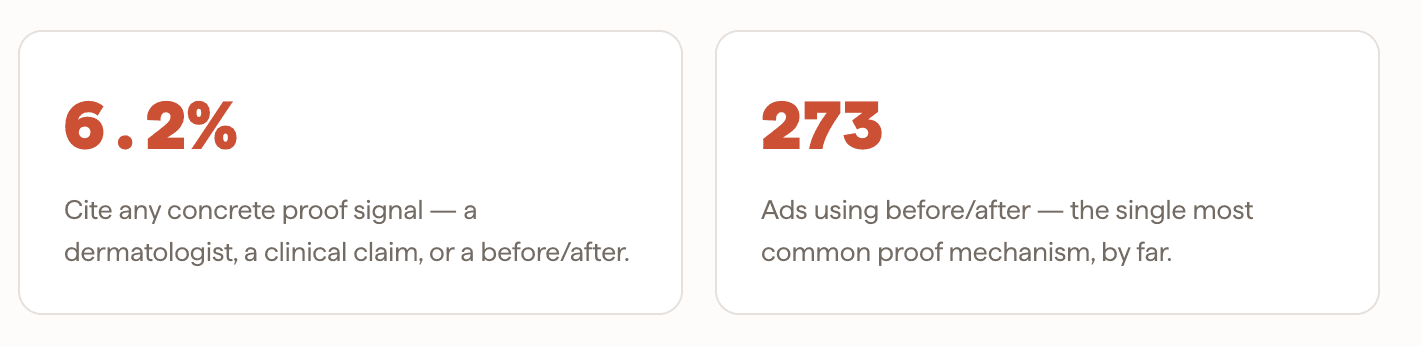
Only 6.2% of ads (388 of 6,229) reference any concrete proof/credibility signal at all.
Where signals do appear:
Signal | Count |
|---|---|
Before/after | 273 |
Dermatologist | 54 |
Clinical | 41 |
Doctor | 30 |
Board-certified | 5 |
Certified | 5 |
Study/studies | 4 |
Clinically proven | 2 |
Before/after is by far the dominant proof mechanism. This is not surprising, since it's a proof format skincare has access to that most other product categories structurally don't.
The headline finding is the 93.9% of ads that make no concrete credibility claim at all. Most skincare creative in this category is winning on hook and value-prop framing, not on demonstrated evidence. This tracks with the low rate of "clinical/dermatologist" language specifically: practitioner language dominates over medical-authority framing.
This could be interpreted in several ways (and does NOT mean the effectiveness of the products can't be proven at all)
Meta places restrictions on what it interprets as medical advertising, which leads many advertisers across product categories to be mindfull of claims that could be interpreted as medicine.
Explicit credibility is currently not an effective promotion method in this ad category
Explicit scientific proof doesn't exist (at least yet)
Deeper studies can be impossible for many newer brands to do
Unless this is a matter of efficacy in ads, there is a clear opportunity here. Brands that are able to produce stronger credibility signals and scientific proof, could potentially stand out from competitors quite easily given the low level of these claims at the moment.
5.9 Value props: anti-aging is the clear leader
Category-wide distribution (ad-level, one ad can have several value props):
Value prop | Ads | Share |
|---|---|---|
Anti-aging / fine lines & wrinkles | 2,655 | 42.6% |
Hydration & barrier repair | 1,847 | 29.6% |
Pore refinement / texture & tightening | 1,502 | 24.1% |
Hyperpigmentation / dark spots & brightening | 1,436 | 23.0% |
Acne & blemish control | 1,127 | 18.1% |
Body / spa & self-care ritual | 948 | 15.2% |
Beauty routine / multi-step regimen | 925 | 14.8% |
General / other | 633 | 10.2% |
Clean / natural / hormone-safe formulation | 586 | 9.4% |
Personalized / prescription skincare | 519 | 8.3% |
Sun protection (SPF) | 442 | 7.1% |
Scar & skin recovery | 335 | 5.4% |
Anti-aging is the clear leader. At 42.6% it's the single value prop most likely to appear on any given ad in this category, well ahead of hydration in second place.
Taken together with the proof signal findings, the picture is: this category sells anti-aging and hydration outcomes primarily through hook and framing.
5.10 Top 3 creative directions
Clustering all 6,229 ads by format, primary value prop, person/product shown and promo strategies surfaces 152 distinct combinations.
The top 3 by frequency:
1. "The anti-aging talking head" — Video + person + anti-aging + no promo. 18.2% of every ad in the category (1,135 ads). By far the single most common creative recipe in DTC skincare: someone on camera talking through an anti-aging claim, no discount attached. Seen across nearly every brand in the dataset, most heavily in Asarai, LifeCell Skin, and Caldera + Lab.
2. "The acne testimonial" — Video + person + acne & blemish + no promo. 9.1% (570 ads). The acne-focused counterpart to #1 — same format, different concern. Strongest in Asarai and CLEARSTEM Skincare.
3. "The anti-aging static" — Image + person + anti-aging + no promo. 6.4% (398 ads). The still-image version of #1, most common at Beauty Pie.
Promo-free framing dominates every top recipe. Discount/promo mechanics are present across brands overall but don't define the category's most common creative patterns, they're layered onto a smaller share of ads rather than being the default framing.
5.11 K-beauty vs. Western-DTC creative convention comparison
Five brands in this dataset are explicitly Korean skincare or K-beauty-styled (NIDA Skincare, Saeskyn, Quasi, Skin Cupid, Medicube), so we decided to also analyze if these brands have some characteristic differences when compared to the other "western style" brands.
Caveat up front: this was a total of 1,171 ads from 5 brands vs. 5,063 ads from 20 brands. The analyzed K-beauty brands has a clearly higher creative volume so you should read the direction of these differences, not the preci.
Dimension | K-beauty (5 brands, 1,171 ads) | Western-style DTC (20 brands, 5,063 ads) |
|---|---|---|
Format mix | Video 68.6%, Image 26.4%, DCO 3.8%, Carousel 0.9% | Video 40.1%, Image 25.7%, DCO 33.5%, Carousel 0.3% |
Median running duration | 65 days | 73 days |
Top value props | Anti-aging 65.1%, Hydration 49.4%, Pore refinement 42.6% | Anti-aging 37.4%, Hydration 25.0%, Hyperpigmentation 21.6% |
Gender (of person-present) | Female 83.1%, Multi 9.0%, Male 8.0% | Female 83.5%, Male 10.3%, Multi 6.3% |
The clearest structural difference is format. The analyzed K-beauty brands are overwhelmingly video-first (68.6% vs. 40.1%) and don't run high volumes of DCO creative (3.8% vs. 33.5%, nearly a 9x gap).
On value props, K-beauty actually skews more concentrated on anti-aging (65.1% vs. 37.4%) and pore refinement than the rest of the category. The "K-beauty routine" framing isn't replacing a skin-concern claim, it's layered on top of the same anti-aging/hydration/pore-texture concerns as everywhere else, just with a routine-based delivery convention.
Longevity and gender mix are close to identical between the two groups — the difference here is entirely in how the message gets made and delivered, not in what it claims or who it's aimed at.
6. Named Brand Spotlights
Here are three brand spotlights based on highest number of live ads. All three profiles are genuinely distinct from each other: a video-first concentrated-testing approach, a DCO-at-scale approach, and a moderate-mix anti-aging specialist.
Based on this, it's worth noting that high ad volume in this category doesn't correlate with any one production model.
6.1 Medicube — 506 ads, the largest brand in the dataset.
Almost entirely hand-produced video (85.0%, essentially no DCO at 5.3%) — the opposite production model from most of the other high-volume brands in this category.
A meaningful share of that inventory clusters around a handful of core products (its pore-care line especially) tested with many distinct copy and hook variants rather than hundreds of genuinely unrelated concepts. It's high volume, but concentrated. Some of their creatives have been live for a very long time already: longest-running ads have been live for over 2.5 years!
6.2 Summer Fridays — 447 ads, and the clearest DCO-as-strategy example in the category
60.2% of Summer Fridays' live inventory is DCO, putting it squarely in the "structural DCO commitment" cluster.
Its top value props are hydration/barrier repair and body/spa framing, consistent with its brand positioning, and its longest-running ad (a gift-with-purchase promotion) has been live for over a year.
6.3 Caldera + Lab — 420 ads, and the category's clearest anti-aging concentration
460 of Caldera + Lab's value-props are anti-aging, which is the highest raw anti-aging count of any brand in the dataset. They're delivered through a more moderate format mix (57.6% video, 20.5% DCO) than either Medicube or Summer Fridays. As a men's grooming-adjacent brand, it's also the single largest driver of the category's ~10% male-talent share.
7. Cross-Brand Comparison Matrix
Brand | Ads | Creative mix (DCO / Video / Image / Carousel %) | Person% | Gender | Median days | Top value prop |
Medicube | 506 | 5.3 / 85.0 / 8.7 / 0.8 | 90.9 | Female | 73 | Pore refinement / texture & tightening |
Summer Fridays | 447 | 60.2 / 9.6 / 30.2 / 0.0 | 58.2 | Female | 43 | Hydration & barrier repair |
Caldera + Lab | 420 | 20.5 / 57.6 / 21.0 / 1.0 | 91.2 | Male | 88 | Anti-aging / fine lines & wrinkles |
Ecloura | 391 | 1.8 / 77.5 / 20.7 / 0.0 | 88.2 | Female | 55 | Acne & blemish control |
Kojeva | 365 | 0.0 / 70.7 / 29.0 / 0.0 | 83 | Female | 29 | Pore refinement / texture & tightening |
Musely | 347 | 0.0 / 41.2 / 58.5 / 0.0 | 88.2 | Female | 100 | Personalized / prescription skincare |
Saeskyn | 337 | 1.2 / 52.2 / 46.3 / 0.0 | 75.1 | Female | 72 | Anti-aging / fine lines & wrinkles |
Frøya Organics | 332 | 69.3 / 12.7 / 17.2 / 0.6 | 59 | Female | 87 | Anti-aging / fine lines & wrinkles |
KahunaSpa | 317 | 0.0 / 97.2 / 2.5 / 0.0 | 95.3 | Female | 57 | Anti-aging / fine lines & wrinkles |
Beauty Pie | 306 | 69.3 / 23.2 / 6.9 / 0.0 | 91.2 | Female | 84 | Anti-aging / fine lines & wrinkles |
NAYDAYA | 287 | 90.2 / 7.0 / 2.8 / 0.0 | 94.8 | Female | 77 | Body / spa & self-care ritual |
Supergoop! | 270 | 61.1 / 15.2 / 22.2 / 0.7 | 60 | Female | 60 | Sun protection (SPF) |
Bubble | 251 | 5.6 / 12.4 / 79.7 / 0.8 | 81.3 | Female | 92 | Body / spa & self-care ritual |
Skin+Me | 234 | 71.4 / 6.4 / 21.8 / 0.0 | 68.8 | Female | 32 | Personalized / prescription skincare |
PORE FAVOR | 224 | 41.5 / 47.8 / 9.4 / 0.4 | 74.1 | Female | 72 | Acne & blemish control |
CLEARSTEM Skincare | 220 | 35.5 / 54.5 / 10.0 / 0.0 | 77.7 | Female | 86 | Acne & blemish control |
LifeCell Skin | 201 | 46.3 / 27.4 / 24.9 / 1.0 | 72.1 | Female | 89 | Anti-aging / fine lines & wrinkles |
Quasi | 173 | 1.2 / 41.6 / 57.2 / 0.0 | 87.3 | Female | 35 | Anti-aging / fine lines & wrinkles |
Asarai | 153 | 10.5 / 84.3 / 5.2 / 0.0 | 98 | Female | 74 | Hyperpigmentation / dark spots & brightening |
NIDA Skincare | 123 | 0.8 / 85.4 / 8.1 / 4.9 | 91.9 | Female | 74 | Anti-aging / fine lines & wrinkles |
Lumera | 116 | 6.9 / 26.7 / 65.5 / 0.0 | 98.3 | Female | 160 | Anti-aging / fine lines & wrinkles |
Féline Skinscience | 96 | 1.0 / 36.5 / 61.5 / 0.0 | 91.7 | Female | 60 | General / other |
Pluune | 81 | 0.0 / 45.7 / 51.9 / 2.5 | 64.2 | Female | 116 | Scar & skin recovery |
Skin Cupid | 32 | 31.2 / 62.5 / 0.0 / 3.1 | 87.5 | Female | 63 | Hydration & barrier repair |
8. Summary of Identified Patterns and Opportunities
Most saturated patterns:
Anti-aging is the default claim, delivered by a person on camera, in a video, with no promo attached. This single combination covers nearly one in five ads industry-wide.
Production model is a binary choice, not a spectrum: brands are either running DCO at 38%+ of inventory or under 11%. There's essentially no "we do a little DCO" middle tier.
Proof is rare across the board (93.9% of ads make no concrete credibility claim). This isn't one brand's gap, it's a category-wide pattern.
What almost nobody is doing:
Concrete proof, at scale. Only 6.2% of ads reference anything demonstrable. Before/after is the dominant mechanism where proof exists at all, but it's still a small minority of the category's total volume. A brand willing to lean harder into visible, repeated before/after proof (rather than hook-only framing) would be doing something genuinely uncommon here, not just "more of the same but better."
DCO + K-beauty, combined. K-beauty brands have almost entirely opted out of dynamic-creative-at-scale (3.8% vs. 33.5% for the rest of the category). No K-beauty brand in this dataset is running Dynamic Creative at the scale a third of Western-style DTC brands rely on. Whether that's a deliberate format choice or an unexplored opportunity is worth considering.
Non-anti-aging positioning in a DCO-heavy ad portfolio. Every brand in the DCO-heavy cluster (NAYDAYA, Skin+Me, Beauty Pie, Frøya Organics, Supergoop!, Summer Fridays) leads with either anti-aging, hydration, or SPF — none of the DCO-heavy brands lead with acne, scar recovery, or personalized/prescription positioning. Those concerns are being addressed almost entirely through single image/video creative in this dataset. There might be some opportunities here worth exploring.
9. Conclusion
DTC skincare's live creative right now splits along one clear line: brands running dynamic creative at scale, and brands that aren't, with very little in between. Anti-aging is the claim nearly everyone reaches for regardless of which side of that line they're on, and almost nobody is backing it with visible proof – the category is winning on hook and framing. K-beauty brands are the clearest exception to the production-model split, running video-first and almost entirely outside the DCO cluster.
These are all creative trends worth exploring for your brand, if you aren't doing so already. They're also a great starting point for brands that want to stand out from the pack.
We hope you've found this report useful. If you want to speed up creative velocity, improve production management, analyze your creative production more deeply and connect it with ad performance data, or just know what has worked and what to brief next, you can book a call with the Focal team here.
Appendix
Hook technique / tag taxonomy glossary
Term | Plain-language definition |
Authority | Leans on expert/professional credentials or status rather than peer testimony |
Before-and-after | Visual or verbal split-state comparison — skin condition before use vs. after |
Curiosity gap | Opens with a question or incomplete statement designed to make the viewer want the answer before they'll get it (e.g. "the one thing dermatologists won't tell you") |
DCO (Dynamic Creative Optimization) | Meta auto-assembles many ad variants from a pool of creative components (images, headlines, CTAs) and tests combinations against audiences — appears in this data as many distinct ad entries sharing production lineage, not hand-built one-off creative |
FOMO (fear of missing out) | Urgency framing around a limited window, stock, or offer |
Pain point | Opens by naming a frustration or discomfort directly, without a question |
Pattern interrupt | A visually or verbally jarring opener meant to stop the scroll, unrelated to the product claim itself |
POV | "Point of view" framing — shot/narrated as if the viewer is experiencing it directly |
Problem-solution | Names a specific pain point first, then presents the product as the fix |
Relatability | Leans on shared, everyday experience to build connection before the pitch |
Secret / insider knowledge | Frames the product as a lesser-known discovery or industry secret |
Shock value | Deliberately jarring or provocative opening image or claim |
Social proof | Leans on other people's reactions, reviews, or endorsement ("everyone's talking about...") |
Transformation | Frames the product around a change-over-time narrative, distinct from a single before/after shot |
Valueprop | The tagged skin concern or positioning an ad is built around (see 5.9 for the full taxonomy) |
Limitations
Snapshot of Meta ads only, pulled mid-July 2026, `longest_running` order (not a random or performance-ranked sample).
No spend/CTR/performance data. Longevity (`running_duration`) is used as the closest available proxy for "creative that's working," not a substitute for real performance data.
DPA excluded entirely. DCO retained.