Creative strategy overview: meal kit and meal delivery brands
What creative strategies, hooks and value props are meal delivery brands running right now? An analysis of 5246 live Meta ads from 8 advertisers.

Series note: This report is part 1 of a two-part food delivery analysis. Part 2, on-demand delivery marketplaces (DoorDash, Uber Eats, Deliveroo, Grubhub), will be released later.
1. Executive Summary
This report analyzes 5,246 distinct ads – with 9,584 individual creative assets, as Dynamic Creative and carousel ads can contain multiple creatives – across 8 subscription meal delivery brands with live Meta ad inventory: four meal-kit brands (HelloFresh, Gousto, Blue Apron, Home Chef) and four ready-meal prep brands (Frive, Simmereats, Factor, CookUnity).
Five things stood out:
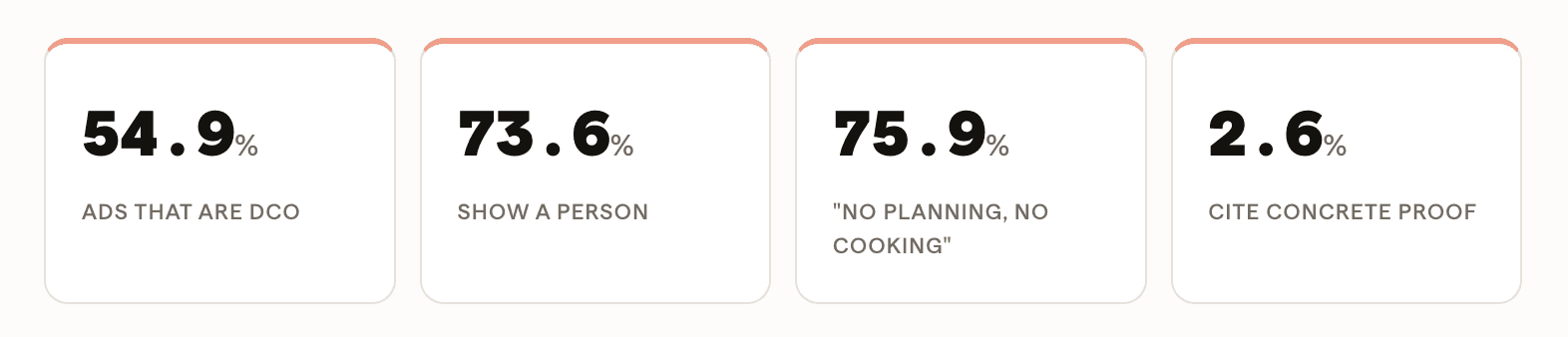
DCO dominates this category more than any prior vertical analyuzed. 54.9% of all ads are Dynamic Creative, the single largest format share we've seen in this series — ahead of video (33.0%) and image (10.8%) combined by a wide margin. See 5.1.
"No planning, no cooking" and "Price, savings & promo" are the two default claims, appearing on 75.9% and 74.9% of ads respectively — far ahead of any other value prop. See 5.2.
Health & nutrition framing is the sharpest split between the two sub-segments.** Ready-meal brands lead with it on 73.3% of ads; meal-kit brands use it on just 18.5%. See 5.10.
Family/social occasion framing is almost exclusively a meal-kit convention** — 23.8% of meal-kit ads use it, versus 1.5% of ready-meal ads. Cooking together is marketed as a shared activity; heating up a meal is marketed as a solo convenience. See 5.10.
2. Introduction
This is the third entry in an ongoing series looking at how DTC categories actually build ad creative based on what is live on Meta right now. The first two entries covered DTC supplements and skincare. This one covers subscription meal delivery: brands that ship either a cook-it-yourself ingredient kit (meal-kit) or a fully-prepared, heat-and-eat meal (ready-meal prep) on a recurring basis.
This is neutral market research on public ad creative available on the Meta ads library, not a pitch for any particular brand.
3. Methodology & Scope
Brands analyzed: 8 subscription meal delivery brands (see full list in Appendix A), split into two sub-segments:
Meal-kit (cook-it-yourself): HelloFresh, Gousto, Blue Apron, Home Chef
Ready-meal prep (heat-and-eat): Frive, Simmereats, Factor, CookUnity
Data source: A swipe file app was used to pull english-language live ads from each brand. As with prior reports in this series, there's no spend or CTR data attached, so every finding below is a directional read on what was live in mid-July 2026, not a performance ranking. The amount of days ads have been live is used as the closest available proxy for creative that's working.
DCO card handling: Every DCO/carousel ad's cards were collapsed back into a single ad-level row before computing format mix, value props, or any other stat — otherwise a 16-card DCO ad would count 16x against a 1-card static ad. Value props, promo, talent, and location fields were merged across an ad's cards.
4. Category Snapshot
Metric | Value |
|---|---|
Brands analyzed | 8 (4 meal-kit, 4 ready-meal prep) |
Total tagged creative assets (individual files, incl. every DCO/carousel card) | 9,584 |
Distinct ads (deduped, one row per ad regardless of card count) | 5,246 |
Format mix (ad-level) | DCO 54.9% · Video 33.0% · Image 10.8% · DPA 0.9% · Carousel 0.6% |
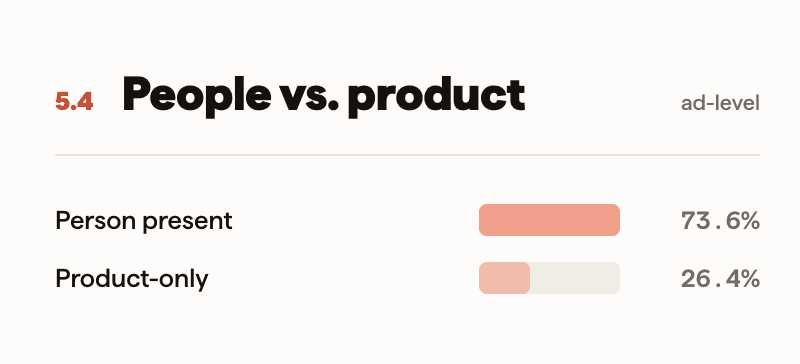
Person present in ad | 73.6% (product-only: 26.4%) |
Dominant talent gender (of person-present ads) | Female 40.5%, Male 28.8%, Multi/group 25.9%* |
Median running duration | 59 days |
Longest-running ad still live | 665 days (HelloFresh, "$4.99/Meal Deal") |
5. Dimension-by-Dimension Analysis
5.1 Format mix: DCO is the default, not the exception
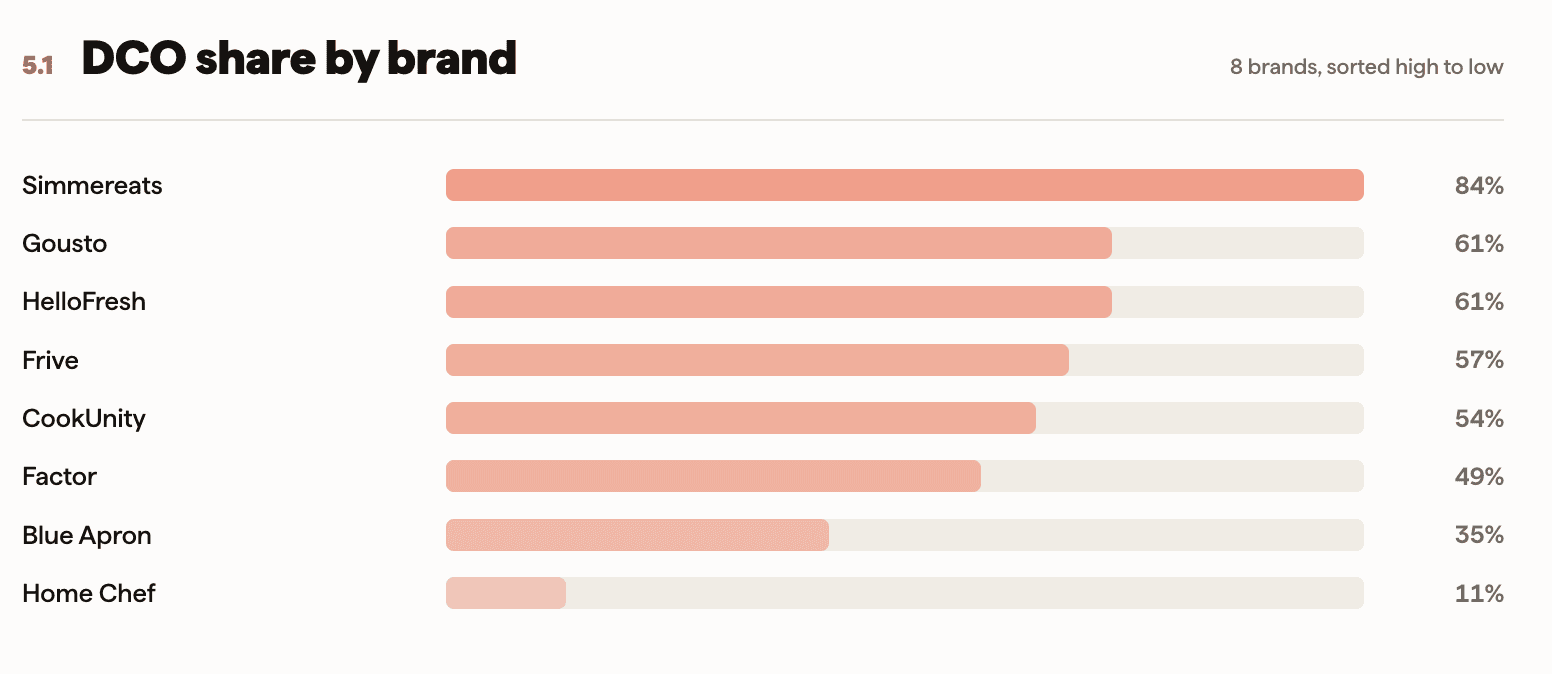
Category-wide: DCO 54.9%, Video 33.0%, Image 10.8%, Carousel 0.6%, Other 0.9%.
This is a meaningfully different profile from either prior vertical in this series. DCO alone accounts for more than half of every live ad in this category, a higher single-format concentration than skincare's video lead (45.5%) or its DCO share (27.9%).
Per-brand format mix:
Brand | Ads | DCO% | Video% | Image% |
Blue Apron | 649 | 35% | 54% | 5% |
CookUnity | 444 | 54% | 41% | 4% |
Factor | 1,091 | 49% | 37% | 13% |
Frive | 515 | 57% | 29% | 13% |
Gousto | 391 | 61% | 33% | 6% |
HelloFresh | 332 | 61% | 30% | 8% |
Home Chef | 535 | 11% | 53% | 32% |
Simmereats | 1,289 | 84% | 10% | 6% |
Every brand except Home Chef runs DCO at 35%+ of inventory. Simmereats runs it at 84%, the single highest DCO concentration seen anywhere in this report series so far. Home Chef is the clear outlier, running a video-first, image-heavy mix (53% video, 32% image) with DCO at just 11%. In this category, DCO is the near-universal default.
5.2 Value props: "We solved dinner" beats every other claim
The used value props as percentage of all ads are as follows:
Value prop | % of ads |
|---|---|
No planning, no cooking | 75.9% |
Price, savings & promo | 74.9% |
Health & nutrition | 53.3% |
Quality & freshness of ingredients | 47.0% |
Speed & convenience | 33.0% |
Variety & selection | 29.6% |
Taste & satisfaction | 27.8% |
Family / social occasion | 9.6% |
Dietary accommodation | 4.9% |
Membership / subscription value | 2.4% |
"No planning, no cooking": eliminating the mental and physical labor of deciding what's for dinner, not just the time it takes, is the single most common claim in the category, essentially tied with price/promo messaging. Together these two claims appear on three out of every four ads. Nutrition and ingredient-quality claims come next, well ahead of pure speed/convenience or variety messaging.
Notably, "membership / subscription value" is the least-used value prop in the entire taxonomy (2.4%) despite every single brand in this report being a subscription business by definition. Brands overwhelmingly frame the pitch around what the subscription eliminates (planning, cooking) or costs (price/promo), not around the subscription mechanic itself — a sharp contrast with the on-demand marketplace report, where membership programs (DashPass, Grubhub+, Uber One) are a first-class recurring theme.
5.3 Promo mechanics: discounting is common but not universal
Promo type | % of ads |
|---|---|
No promo tagged | 53.5% |
Discount % | 36.8% |
Free Product | 5.8% |
Promo Code | 2.6% |
Free Shipping | 1.3% |
A straightforward percentage discount is the dominant promo mechanic where a promo exists at all, well ahead of free-product or code-based offers. Combined, roughly a third of ads run with no promotional mechanic at all, meaning promo-free framing is common but discounting is still the default lever most brands reach for first.
5.4 Talent: three out of four ads use a person, format changes who and how
Gender (category-wide) | % of all ads |
|---|---|
Female | 31.3% |
Product-only (no person) | 26.4% |
Male | 22.2% |
Multi/group | 20.0% |
Person-present rate varies sharply by format: 90.3% of video ads feature a person, versus 72.5% of Dynamic Creative ads and just 34.9% of image ads. Video is overwhelmingly a talking-head or lifestyle-demonstration format here; static images lean product-only far more often.
Of person-present ads, talent presentation is overwhelmingly casual (72.2%), with a meaningful sport/athletic-styled minority (23.0%) — plausibly linked to the "Health & nutrition" and "Weight management / GLP-1-friendly" framing common in the ready-meal segment — and only a small elegant/upscale share (2.2%).
5.5 Location: the kitchen is still the default setting
Location | % of all ads |
|---|---|
Kitchen | 62.8% |
Outdoor | 8.4% |
Indoor – other | 5.9% |
Gym | 2.4% |
Living room | 2.3% |
Nearly two-thirds of every ad in this category is shot in a kitchen, unsurprising for a food-delivery product, but worth noting as a baseline: it means the category's actual creative differentiation currently happens within a narrow visual setting, not through varied location choices. There is clearly some opportunity for standing out here.
5.6 Hook technique: pain point framing leads, but the mix is broad
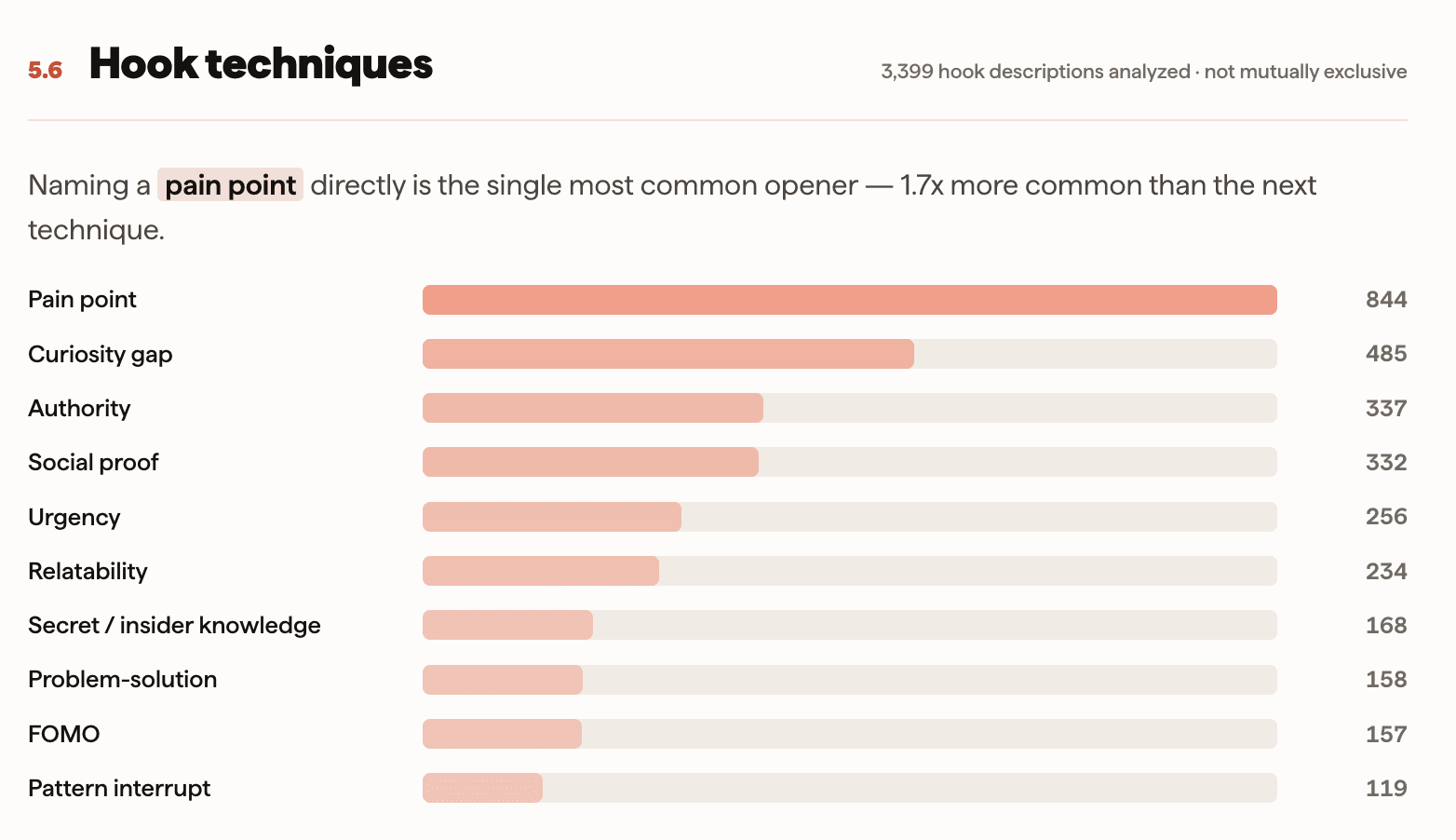
Of the 3,399 ads with a video hook (64.8% of all ads), the most common techniques used were as follows:
Technique | % of tagged hooks |
|---|---|
Pain point | 24.8% |
Curiosity gap | 14.3% |
Authority | 9.9% |
Social proof | 9.8% |
Urgency | 7.5% |
Relatability | 6.9% |
Secret / insider knowledge | 4.9% |
Problem-solution | 4.6% |
FOMO | 4.6% |
Naming a frustration directly (pain point) is the single most common opener, roughly 1.7x more common than the next-most-frequent technique (curiosity gap). This tracks with the category's dominant value prop. "No planning, no cooking" is fundamentally a pain-point-first pitch (the exhaustion of deciding what's for dinner), so the hook and the core claim are usually the same idea stated twice, once as a feeling and once as a solution.
5.7 Proof/credibility signals: almost entirely absent
Although we weren't expecting them to have a major role here, 135 ads (2.6%) did cite concrete proof signals: a named dietitian, a clinical or research claim, or an expert credential.
Different types of features proof include the following:
"Expert" is the most common single term (82 mentions)
"Dietitian": 45 mentions
"Nutritionist": 12 mentions
Named clinical or research claims are vanishingly rare: (2–3 mentions each)
Although we weren't expecting a high occurrence of these, it should be noted that the category makes health and nutrition claims on over half of all ads (see 5.2). The "Health & nutrition" value prop is almost never backed by a named credential or study, it's asserted, not demonstrated.
5.8 How many days have ads been live: winners run for well over a year
Category-wide median time an ad stays live is 59 days. The single longest-running ad in the dataset – a "$4.99/Meal Deal" promotion – has been live for 665 days, just under two years.
Brand | Median days live | Longest days live |
|---|---|---|
Gousto | 96 | 475 |
HelloFresh | 95 | 665 |
CookUnity | 69 | 441 |
Factor | 62 | 348 |
Simmereats | 54 | 357 |
Blue Apron | 44 | 322 |
Home Chef | 36 | 662 |
Frive | 26 | 347 |
Every brand in this category has at least one ad that has been live for 300+ days, and two brands (HelloFresh, Home Chef) have a single ad running past 660 days — creative that clearly keeps converting well past the category's ~2-month median.
5.9 The category's top creative recipe
The single most common combination of format, talent, and leading value prop is a DCO ad, with a person on camera, and "Health & nutrition" as the primary claim. This is the recipe for 1,294 ads, or 24.7% of the entire category!
The next-most-common combination (video + person + health & nutrition) accounts for a further 12.2%.
There's at least two takeaways: make sure you are running at least this format (it's clearly working), but also make sure you stand out and don't restrict yourself to just following these two formulas.
5.10 Meal-kit vs. ready-meal prep: the split that justified two segments in one report
Splitting the 5,246 ads by sub-segment surfaces genuine, not just cosmetic, differences in what each side sells:
Dimension | Meal-kit (4 brands, 1,907 ads) | Ready-meal prep (4 brands, 3,339 ads) |
|---|---|---|
Top value prop | Price, savings & promo (84.2%) | No planning, no cooking (76.4%) |
Health & nutrition | 18.5% | 73.3% |
Family / social occasion | 23.8% | 1.5% |
Dietary accommodation | 2.6% | 6.2% |
Variety & selection | 31.0% | 28.8% |
Family/social occasion is the sharpest divide. Nearly a quarter of meal-kit ads frame cooking as a shared activity — family dinner, date night, entertaining — versus essentially none of the ready-meal ads. This tracks with the underlying product: a meal-kit is something you cook together; a ready-meal is something one person heats up alone.
Health & nutrition is the second sharp divide, and runs the opposite direction: ready-meal brands lead hard on nutrition/macro framing (protein counts, calorie control, dietitian-adjacent claims), while meal-kit brands lean far more on price/value and the shared-cooking-experience angle.
Both segments converge closely on "no planning, no cooking" and variety messaging — the baseline convenience pitch is shared, but the emotional register built on top of it diverges by product type.
6. Named Brand Spotlights
Top 3 brands by creative count:
1. Simmereats: 2300+ creatives across 1000+ ads, with the highest DCO concentration in the category. 84% of its inventory is Dynamic Creative, by far the most DCO-committed brand in this report (the next-closest, Gousto, sits at 61%).
2. Factor: 1900+ creatives across 1,000+ ads, the category's clearest health/nutrition specialist. Factor is a HelloFresh-owned ready-meal brand and leads the category on median duration among high-volume brands (62 days) with a near-even DCO/video split (49%/37%).
3. Blue Apron. 1300+ creatives across 600+ ads, and the closest thing to a video-first outlier alongside Home Chef. 54% video vs. 35% DCO means they're a meal-kit brand that, unlike its three meal-kit peers (all DCO-majority), still leans on single video as its primary format.
7. Cross-Brand Comparison Matrix
Brand | Ads | Creative mix (DCO/Video/Image %) | Person% | Dom. gender | Median days live | Dominant value prop |
|---|---|---|---|---|---|---|
Simmereats | 1,289 | 84 / 10 / 6 | 77% | Male | 54 | Health & nutrition |
Factor | 1,091 | 49 / 37 / 13 | 79% | Female | 62 | Health & nutrition |
Blue Apron | 649 | 35 / 54 / 5 | 75% | Female | 44 | No planning, no cooking |
Home Chef | 535 | 11 / 53 / 32 | 52% | Female | 36 | Price, savings & promo |
Frive | 515 | 57 / 29 / 13 | 73% | Male | 26 | No planning, no cooking |
CookUnity | 444 | 54 / 41 / 4 | 88% | Multi | 69 | No planning, no cooking |
Gousto | 391 | 61 / 33 / 6 | 57% | Female | 96 | Price, savings & promo |
HelloFresh | 332 | 61 / 30 / 8 | 75% | Female | 95 | Price, savings & promo |
8. Summary of Identified Patterns and Opportunities
Most common patterns:
The category sells on eliminating a chore (planning/cooking) and on price, far more than on taste, variety, or nutrition specifics — even though half the category also makes a nutrition claim, it's rarely the lead (see 5.2 and 5.9).
DCO is the default production model for 7 of 8 brands, but Home Chef is the outlier favoring video much more heavily.
Pain-point-first hooks dominate, consistent with a category whose core claim is itself a pain-point resolution (see 5.6).
What almost nobody is doing:
Backing the health claim. Over half the category makes a health/nutrition claim, but only 2.6% cite anything concrete to support it (see 5.7) — there is perhaps opportunity here, given that it's a category where the underlying claim (what's actually in the food) is uniquely verifiable.
Leading with the subscription itself. Every brand here is a recurring subscription business, yet membership/subscription framing is the single least-used value prop in the entire taxonomy (2.4%, see 5.2) – a stark contrast with the on-demand marketplace companion report, where membership programs are a recurring, heavily-promoted theme.
Family/social framing outside meal-kit. Ready-meal brands have almost entirely ceded the "shared meal occasion" angle to meal-kit brands (1.5% vs. 23.8%, see 5.10). Whether that's a deliberate positioning choice (ready-meal as an individual, not shared, product) or an unexplored angle is worth testing.
Conclusion
We hope you've found this report useful. If you want to speed up creative velocity, improve production management, analyze your creative production more deeply and connect it with ad performance data, or just know what has worked and what to brief next, you can book a call with the Focal team here.
Appendix
Tag taxonomy glossary
Term | Plain-language definition |
|---|---|
DCO (Dynamic Creative Optimization) | Meta auto-assembles many ad variants from a pool of creative components and tests combinations against audiences — appears in this data as many distinct ad entries sharing production lineage, not hand-built one-off creative |
No planning, no cooking | The ad frames the product as eliminating the mental/physical labor of deciding what's for dinner and cooking it — distinct from "Speed & convenience," which is about time, not effort/decision-making |
Health & nutrition | General wellness/nutrition claims (protein, calories, dietitian involvement) not specifically about weight loss |
Weight management / GLP-1-friendly | Explicit weight-loss or GLP-1/Ozempic-companion framing — kept distinct from general health claims since it's a specific, emerging claim type in this category |
Membership / subscription value | Ad promotes the paid subscription/membership program itself and its perks, not a one-time promo |
Pain point | Hook opens by naming a frustration or discomfort directly, without a question |
Curiosity gap | Hook opens with a question or incomplete statement designed to make the viewer want the answer |
Authority | Hook leans on expert/professional credentials or status rather than peer testimony |
B. Limitations
Snapshot of Meta ads only, pulled mid-to-late July 2026, English-language only, US/Europe-relevant markets.
No spend/CTR/performance data — this is a swipe-file source. `running_duration` is used as the closest available proxy for "creative that's working," not a substitute for real performance data.