Asana vs. Focal
Asana is a strong general task tracker. Focal is built specifically for ad creative: tagging, channel uploads, and performance. Compare them.

Asana is a genuinely well-liked, flexible task and project management tool, and reviews show it: real customization, real templates, real cross-team visibility. It just wasn't built around ad creative specifically. Focal is: every asset is tagged automatically and natively integrates with the task management, can be reviewed in place, and uploaded directly to Meta, TikTok, and YouTube with performance data connected to it.
A strong general task tracker is still a partial fit for ad creative
Asana is one of the most-liked general project management tools out there for good reason. Reviewers consistently praise its user-friendly interface, flexible templates, portfolio-level views for tracking many projects at once, and rule-based automation for routing work. One agency owner who tested nearly every major PM tool on the market returned to Asana full-time, convinced it "understands its users better than the others."
But Asana wasn't built around ad creative specifically, and its own reviewers say so in detail. A creative agency Founder and Creative Director running a five-person team across 10+ active client accounts in video production, content strategy, and brand management put it plainly: the integration between Asana and tools like Google Drive and Frame.io is "more of a link-drop than a true two-way sync, so we still end up bouncing between platforms to track deliverable status." The same reviewer noted team communication "lives in task comments, which buries conversations inside individual tasks," pushing teams back to Slack for anything broader than a single task.
Search is lacking as well: one reviewer specifically noted that custom properties are "not searchable," and lacking real content-aware search is one of the most-cited complaints in Asana's own aggregate review data.
Asana's AI, while genuinely useful for summarizing project status, isn't aimed at creative content at all. It focuses mostly on task creation, not visuals, and multiple reviewers (including an agency owner who uses AI daily elsewhere) have openly questioned whether it "offers obvious value."
Focal was tailor-made for ad creative teams. Creative project management and assets are natively tied together: assets are tagged automatically by what they actually show, previewed natively including frame-level video scrubbing, reviewed and annotated in place, and uploaded directly to Meta, TikTok, and YouTube with performance data connected on creative level. On creative boards, assets aren't buried into a comment or an attachment but live directly inside the tasks.
Choosing the right tool for your team
Choose Asana if… | Choose Focal if… |
|---|---|
|
|
Or use both: You can also keep Asana for company-wide project management across departments, and run the ad creative operation itself through Focal. You could even automate work between the two platforms so a task card created in Asana gets pushed to Focal and completing it in Focal completes the ask in Asana as well.
What creative and marketing teams say after using Asana
Asana's aggregate reviews are strong. There's more than 1300 mentions of a user-friendly interface, and effective task management. To get a better understanding of fit for creative teams, we read specifically through reviews mentioning creative work, agency operations, and design/marketing roles.
On the integration gap, from a real creative agency's Founder and Creative Director: "The integration between Asana and tools like Google Drive and Frame.io could also be deeper — it's more of a link-drop than a true two-way sync, so we still end up bouncing between platforms to track deliverable status." — G2 reviewer, Founder & Creative Director
On communication getting buried, same reviewer: "I also wish there was a dedicated chat or messaging feature built into Asana — right now team communication lives in task comments, which buries conversations inside individual tasks and makes it hard to have broader project-level or team-wide discussions without jumping to Slack or text threads." — G2 reviewer, Founder & Creative Director
On review meaning task routing, not asset review: "The rules feature helps too. I set it up so that when tasks move to 'Ready to review,' they're automatically assigned to our design lead, rather than me having to remember to tag her every time." — G2 reviewer, Senior Project Coordinator
On a Digital Asset Management Executive using Asana purely for tracking, not asset work: "[Asana] helps automate workflows for different teams within the company... brand teams can efficiently track what the e-commerce and creative teams are working on." — G2 reviewer, Digital Asset Management Executive
On AI not offering obvious value, from an agency owner who uses AI daily elsewhere: "I am not in the anti-AI hivemind. I use AI daily for my and my agency's workflow, but with one qualification: It must provide value. So far, Asana's AI offerings don't offer obvious value... maybe they rushed AI features due to investor pressure without an obvious need." — G2 reviewer, Brand Consultant / Agency Owner
On search not reaching the data that actually matters: "Custom properties are project-based rather than task-type-based, and they are not searchable." — G2 reviewer
Asana's usability and flexibility are genuine, widely-praised strengths, and the agency example above scaled from a solo operation to five people specifically because of the structure Asana gave them. It's just built for tracking work about creative, not for holding, tagging, uploading creatives or understanding how they perform and what kind of creative you should build next.
What teams using Focal say
At the time of writing, Focal sits at 4.7/5 on G2. Where Asana's creative-adjacent reviewers describe a capable task tracker that references the work, Focal's reviewers describe the asset itself living in the platform natively with the task management.
On tagging and naming happening automatically instead of by hand: "My favorite part is the automation features, especially auto-renaming, which saves everyone hours and keeps things consistent and tidy. The AI-automated tagging is amazing too—it really helps with creative insights and reduces manual work." — G2 reviewer, Senior Marketing Animator
On the full path from asset to live channel, in one place: "It helps us to get a clear process for creatives, from storing them to naming them and pushing them to Meta." — G2 reviewer, Marketing and Advertising
Focal's reviewers are just as direct about where things are still improving, including that AI tagging isn't fully reliable on every account yet — the same honest standard we've held Asana to throughout this research.
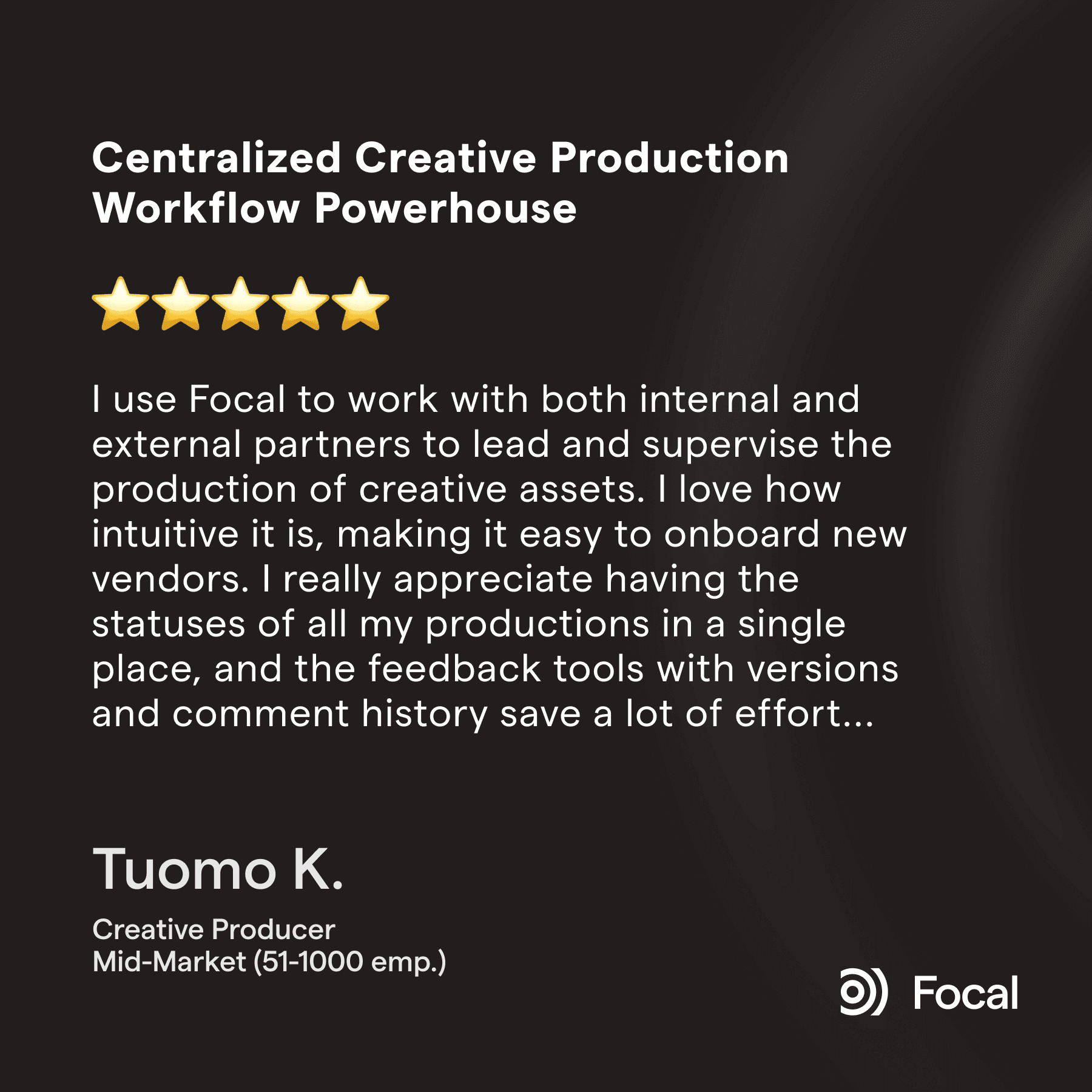
Another review praised Focal's collaboration capabilities as follows:
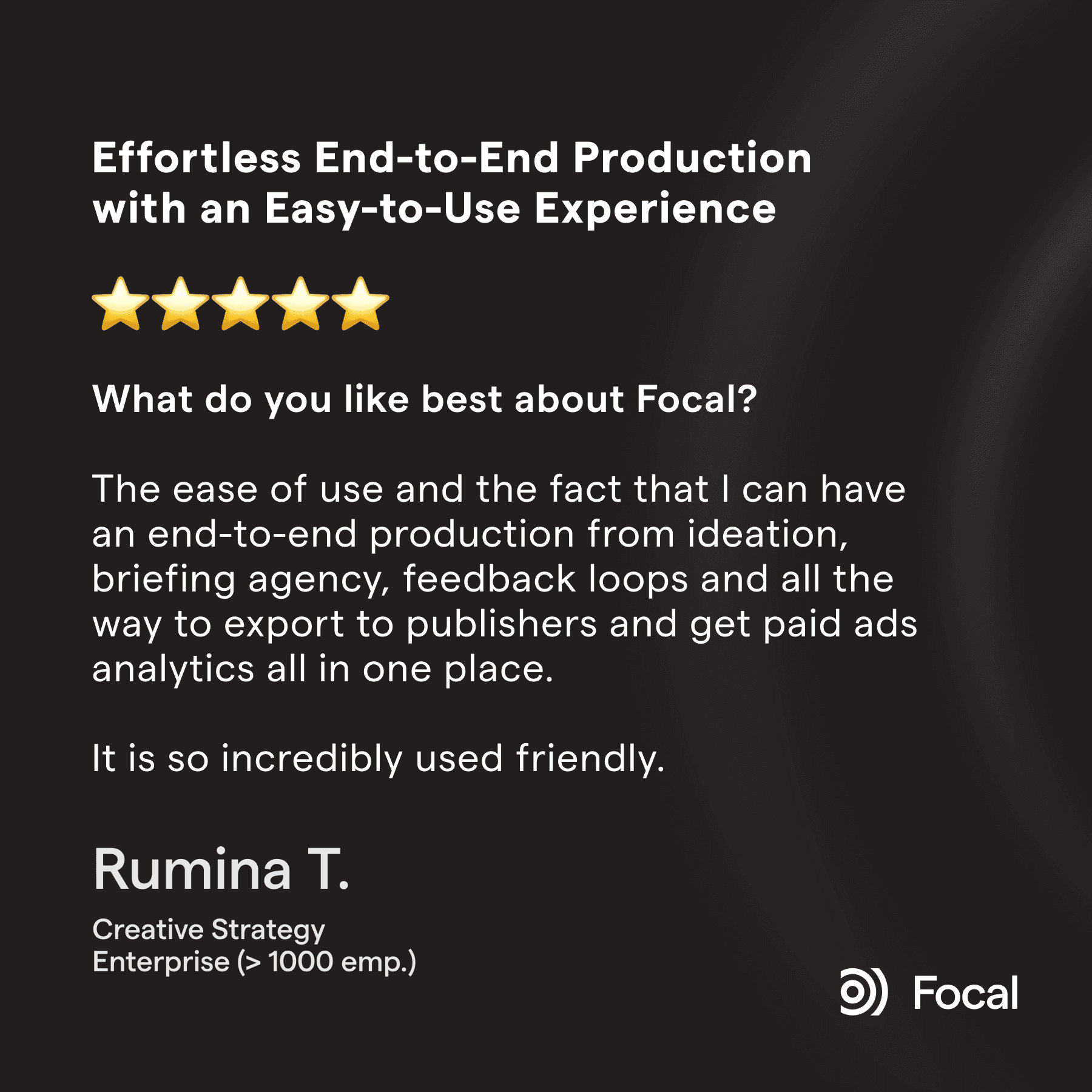
Focal also gets consistent praise for its easy of use and the fact that it works end-to-end for creative production management.
Comparing Asana and Focal features
Asana | Focal | |
|---|---|---|
Native visual preview (video, image content) | Not available — reviewers confirm links don't preview or autoplay; files are referenced, not embedded | Yes, including frame-level video scrubbing. |
Integration depth with asset tools (Drive, Frame.io) | "More of a link-drop than a true two-way sync," per a reviewer | Full two-way sync; assets tagged and organized automatically |
AI tagging, searchable by visual content | Not available — search doesn't extend to visuals | Yes |
Meta, TikTok, YouTube channel uploads | Not available | Native, direct upload |
Performance data connected to the asset | Not available | Yes |
Creative review and annotation on the asset itself | Task-comment based; rules can route a task to a reviewer, but don't annotate the creative | Native, frame-by-frame annotation |
Native workflow automation depth | Real for task routing; complex cross-tool workflows still lean on Zapier | Built-in, including creative-specific actions (auto-rename, auto-tag, channel export) |
Asset organization: Focal's asset library uses AI to tag every creative automatically by what it actually shows, with visual and natural-language search built in. Asana organizes work by task and project; finding a specific creative still means locating the task it's attached to and opening the link.
Creative review and feedback: Asana lets teams comment on tasks and route work through status-based rules. It's useful for task assignment, but reviewers describe wanting a genuine document or asset hub rather than everything living as a task. Focal's review happens directly on the asset, frame by frame, with full version history in the same place.
Custom tagging and naming: Focal applies your own taxonomy automatically on upload and enforces naming conventions without anyone typing them in. Asana's custom fields are powerful for task metadata, but reviewers note they can get messy at scale and aren't searchable the way content-aware tags are.
Channel uploads: Focal uploads approved creative directly to Meta, TikTok, and YouTube, with performance data connected back to the asset. Asana has no equivalent at all based on G2 reviews.
Automation: Asana's rules are genuinely useful for routing tasks and assignments, and several reviewers rely on them daily. But creative-specific actions like auto-renaming a file, auto-tagging by visual content and triggering a channel upload aren't native; reaching that level of automation elsewhere in a stack typically means adding a tool like Zapier on top. Focal's automation covers exactly those actions out of the box.

The Longevity Store is a rapidly growing longevity brand that sells to over 25 countries. They needed a flexible tool that manages large creative production operations and asset volumes, in multiple languages so they migrated from a fragmented stack of multiple tools to Focal.
FAQ
Q: What is the difference between Focal and Asana?
Asana is a well-regarded general task and project management tool used across many departments, with real strengths in customization, templates, and portfolio-level visibility. But it wasn't built around ad creative specifically — one creative agency reviewer described its integration with tools like Google Drive and Frame.io as "more of a link-drop than a true two-way sync," meaning the actual assets still live elsewhere. Focal is built specifically for ad creative: assets are tagged automatically, previewed natively, reviewed in place, and uploaded directly to ad channels with performance data connected to them.
Q: Does Asana work well for creative teams?
Creative teams and agencies do use Asana, and several reviewers describe real value from it for organizing production timelines and client-facing status. But reviewers also describe real limits: a creative agency Founder/Creative Director noted that team communication "lives in task comments, which buries conversations inside individual tasks." A Digital Asset Management Executive who reviewed Asana used it purely to track what creative teams were working on, not to manage the assets themselves.
Q: Can Asana upload ad creative directly to Meta, TikTok, or other ad platforms?
No. Asana has no native upload integration with ad platforms like Meta, TikTok, or YouTube. Across dozens of reviews we read, not one mentioned this capability. Teams using Asana for ad creative still manage channel uploads and performance data entirely outside the tool. Focal has native, direct-upload integrations with Meta, TikTok, and YouTube, with performance data connected directly to each asset.
Q: Does Asana have native creative review and annotation?
Not in the way a creative team needs. Reviewers describe using Asana's rules to route a task to a design lead once it's "ready to review," but that's task assignment, not asset annotation — there's no frame-by-frame commenting on the creative itself. Reviewers consistently describe attaching or linking files rather than reviewing them natively. Focal has native, frame-by-frame annotation built directly into the asset.
Q: Is Asana's AI useful for creative work?
Reviewers are split, and several are openly skeptical. One agency owner who uses AI daily elsewhere said Asana's AI "don't offer obvious value" and speculated it was "rushed... due to investor pressure." Another reviewer called native AI capabilities "limited or hard to get value from." The stronger AI features (Smart Chat, Smart Status) are also gated behind the Advanced plan plus additional usage credits. None of this AI is aimed at creative content specifically. It summarizes and drafts tasks and project status, not visual assets.
Q: Can Asana and Focal be used together?
Yes. A company can keep Asana for general project management across departments while the creative or performance marketing team runs the ad creative operation through Focal — asset library, tagging, briefing, approvals, and channel uploads.
Petteri Jalonen
