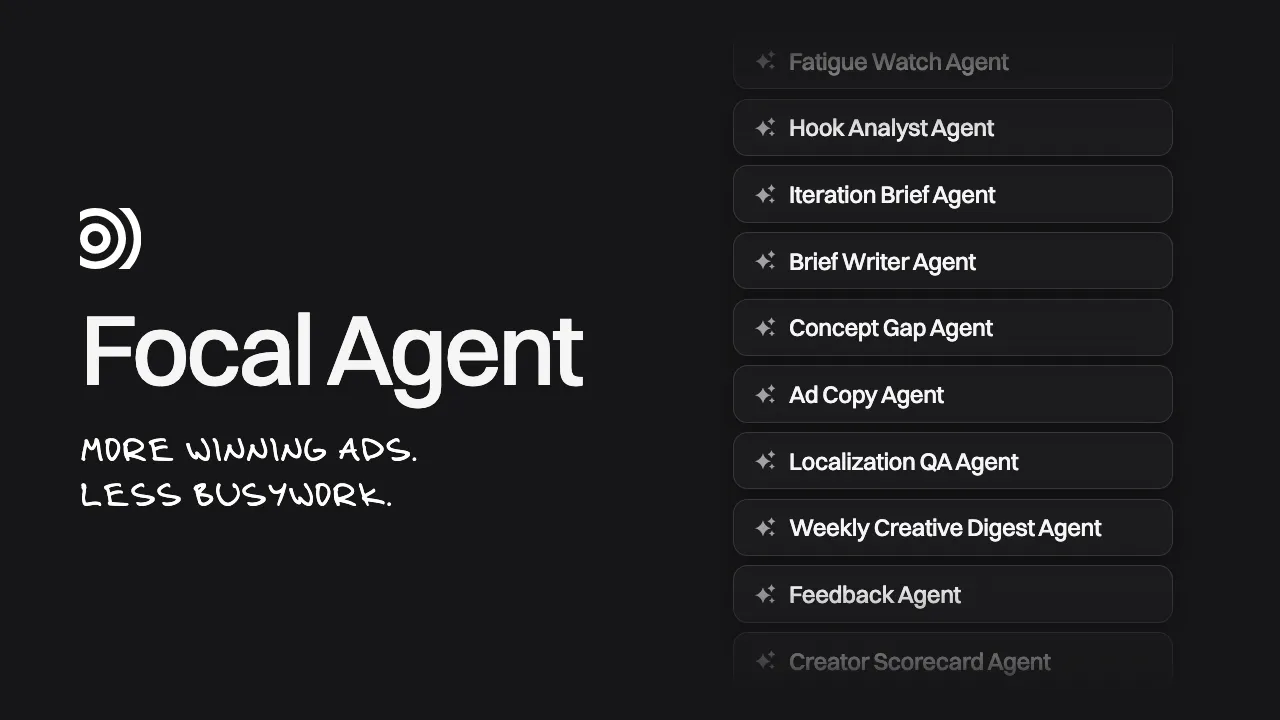
The future of creative work is agentic
In the future, all manual tasks of creative production will be handled by agents. But not all agents are equal at all tasks, and humans will still have a place in the value chain.

When everyone has AI, context is the only edge
Ultimately, all creative tasks where humans don’t add unique value will be done by agents. AI is already making ad production and media buying more accessible for everyone. What’s left to compete on is the creative itself, and how well you and your agents understand it.
We work with creative teams that ship hundreds to thousands of ads a month. The best ones have one thing in common: they can say why their last winner won, and what they’re testing next because of it.
That might sound basic, but very few people can actually answer those questions, even with the help of AI. For most teams, every new round of creative starts closer to zero than it should, because their learnings are spread across briefs in one tool, assets in another, results in Ads Manager and conclusions in Slack threads nobody reopens.
As AI makes ad production cheap for everyone, the gap separating teams that get better from teams that just get faster will widen. We believe creativity will remain a deeply human endeavor, but who handles an individual task will change. All manual chores of creative production will eventually be done by agents, allowing humans to fully focus on creative strategy and other things where they excel.
Ad operations are no longer a differentiator
For most of the last decade, advertisers competed on operations. You won by tweaking bids better, structuring campaigns more cleverly, finding just the right audiences, and producing a few ad variants to feed the algorithm.
Those advantages are mostly gone. Meta moved toward broader targeting years ago, and with the Andromeda update, audience selection is done by the algorithm based on the ad itself.
LLMs have lowered the bar further. Someone who has never opened Ads Manager can now ask an assistant to set up a reasonable campaign and help interpret the results. Ad volume has followed the same path. Generating fifty variants of a static ad used to take a design team a few days. Now it takes a few rounds of prompting and an afternoon.
There are still some gains in channel budget allocation, measurement and account structure. But the returns are shrinking as more teams adopt the same tools.
Creative determines the winners
Without an edge in targeting or production capacity, advertisers are left competing on whether their ads say the right thing to the right person, in a format that resonates.
AI makes it easy to produce more of anything, but more variants without a real hypothesis behind them are just guesswork. You might get lucky and find a new winner, but more often you just end up wasting money and time. The teams that produce a steady stream of winners are the ones whose next batch of ads is informed by what the previous batches taught them.
That takes judgment about who the product is for, which problems matter most to different customers, and which angle hasn’t been tried yet. It also requires memory: knowing what has already been tested, so you aren’t paying to learn the same lesson twice.
AI currently works best as a productivity booster
The most useful AI adoption we see among our customers isn’t replacing people. It’s experienced strategists and editors getting much more done.
Take winner analysis. Working out what your best-performing ads have in common used to mean days of exporting reports and watching videos. Now every creative can be tagged automatically for its hook, visual style, talk track, music and value proposition. Asking “what do our top 50 ads from Q3 have in common, across our three ad accounts?” takes minutes.
Or take editing. A good motion designer who has set up their AI tools well can do a lot of routine cutting, resizing and versioning through prompts, without spending an hour in a timeline.
In both cases, the AI is only as useful as the context it can access and the judgment of the person using it. A strategist with taste and in-depth data asks better questions and spots which patterns actually matter. An editor who knows what a good cut looks like can tell when the AI’s version is wrong.
All creative busywork will be done by agents
We believe all meta-work around creative, the manual chores where humans do not add real value, will eventually be handed off to agents. Things like manual tagging, resizing, QA, reporting, chasing status and rebuilding the same brief for the tenth time will be a thing of the past.
What remains is the part that was always the job: deciding what’s worth saying, how to say it, to whom and why, recognizing a good idea before the data confirms it, and knowing when a winning pattern has run its course.
Those decisions get better with more context, for people and agents alike. Building that context is what we’re focused on at Focal.
An agent is only as good as its context
More and more creative busywork will move to agents. But how well an agent does this work depends entirely on the information it can access.
An agent that only sees one slice of your work produces generic output. Ask a general-purpose assistant for new ad concepts and you’ll get reasonable-sounding ideas that could belong to any brand in your category, because it doesn’t know what you’ve tried or why your best ad worked.
For an agent to do useful creative work, it needs the context a good creative strategist relies:
Who you are. Your product, its core value proposition and the problems it solves for different customers.
Why each asset exists. The brief, the persona it targeted, the hypothesis and the angle.
What the asset actually is. Its format, visual content, style, what’s being said, and every element that can be tagged and compared.
What it cost to make. How much work went into getting it approved and how many versions it required.
What happened. How it performed when used in ads, and which of its elements show up repeatedly in your winners.
In most teams, that context is scattered. Briefs live in Notion or Google Docs, tasks in Asana, assets in Drive, performance in Ads Manager, and learnings in someone’s head or a Slack thread. An agent connected to just one of those systems can’t link a brief to its results, or a hook to its performance.
We think this fragmentation, not model quality, is the real bottleneck for agentic creative work.
Why we built Focal Agent
Focal was built to keep creative work in one connected system: briefs, tasks, assets, reviews and performance data. That’s also why we think it’s the right place for an agent to live.
Focal Agent works from that full context. It sees the brief behind an ad creative as well as its results, so it can explain why a winner probably won and suggest iterations that test something new instead of repeating what you already know. It then helps you create and publish those iterations faster by automating task management, creative QA, ad platform uploads and other associated chores.
Focal Agent also remembers things across your whole team. As well as personal skills and memories, it keeps shared context. Suppose your strategist learns that a certain style of UGC consistently beats polished product demos, or your team agrees on a brief format. That knowledge doesn’t stay in one person’s chat history. Their colleague James, and James’s agent, can use it the next time they plan a batch, and nobody has to test it again.
In practice, teams use it for:
Iterating on winners. Mark a winning ad and the agent drafts variant briefs based on the original hypothesis.
Finding patterns. Ask what your winners have in common across ad accounts and platforms, using Focal’s tags for visual content, hooks, style and value propositions.
Creative QA and brand checks. Check aspect ratios, safe zones, image quality, required promo codes, tone of voice and brand guidelines before anything ships.
Automating routine work. Describe a recurring task in plain language and the agent builds the automation. If you don’t know where to start, ask it what’s worth automating.
For more on the capabilities of Focal Agent, see the Focal Agent feature page.
Focal Agent is available to all Focal users today. Start a free trial or talk to our team to see it working on your own creative.

