Inside Granola's ad creative strategy: 10 lessons from the webinar
Granola's Naomi Haeger on her ad creative strategy: two-week sprints, monthly retros, a creative mix grid, spend concentration and Claude + Focal MCP.

"I like to understand what's working through data before letting my subjective kind of mind think 'Oh, okay, this creative is looking good.'"
Focal Point is our webinar series where we talk to creative strategists and others professionals working on performance creative at large scale. In the first session, Naomi Haeger, Creative Strategist at Granola was joined by Focal CEO Andreas as they discussed a number of creative production topics:
Deriving ideas from data
How to plan your creative production and forecast volume needs
Where in the creative process are Claude and other AI tools genuinely useful, and where do they fall short
Where Focal sits in the loop
This is our overview of the session. You can watch the full session recording below as well.
The setup: creators, freelancers and a push for new audiences
Naomi describes creative strategy as the in-between space between brand and growth, and her remit is performance creative for every channel Granola wants to test. Meta is the main engine today, but they are also active on YouTube and LinkedIn.
Their production operation is fairly complex.
Creator partnerships, some through an agency and some through personal relationships, are a major source of material.
Freelance designers and video editors produce new work and edit existing content.
Before Granola, Naomi worked at a few major DTC brands, where most content was shot in-house, so she's seen both models.
The goal shapes everything else. Granola is past its early adopters, so the job is incrementality: reaching people who haven't heard of the product. That makes creative diversity the main lever on Meta. Naomi works from roughly three core archetypes and then goes after niche personas inside each one to find new winners.
10 ad creative strategy lessons from the session
1. Read the data before you write a single brief
Naomi protects the first half of the week for analysis. She looks at how last week's creatives did and talks to agencies, freelancers and internal team members about what's performing and what's not. Wednesday to Friday is protected for briefing and generating ideas for the next round.
The order is deliberate. Starting from performance keeps her own taste from deciding what looks like a winner before the numbers have said anything. (Watch: weekly routine, 04:35)
2. Alternate a main week and an off week
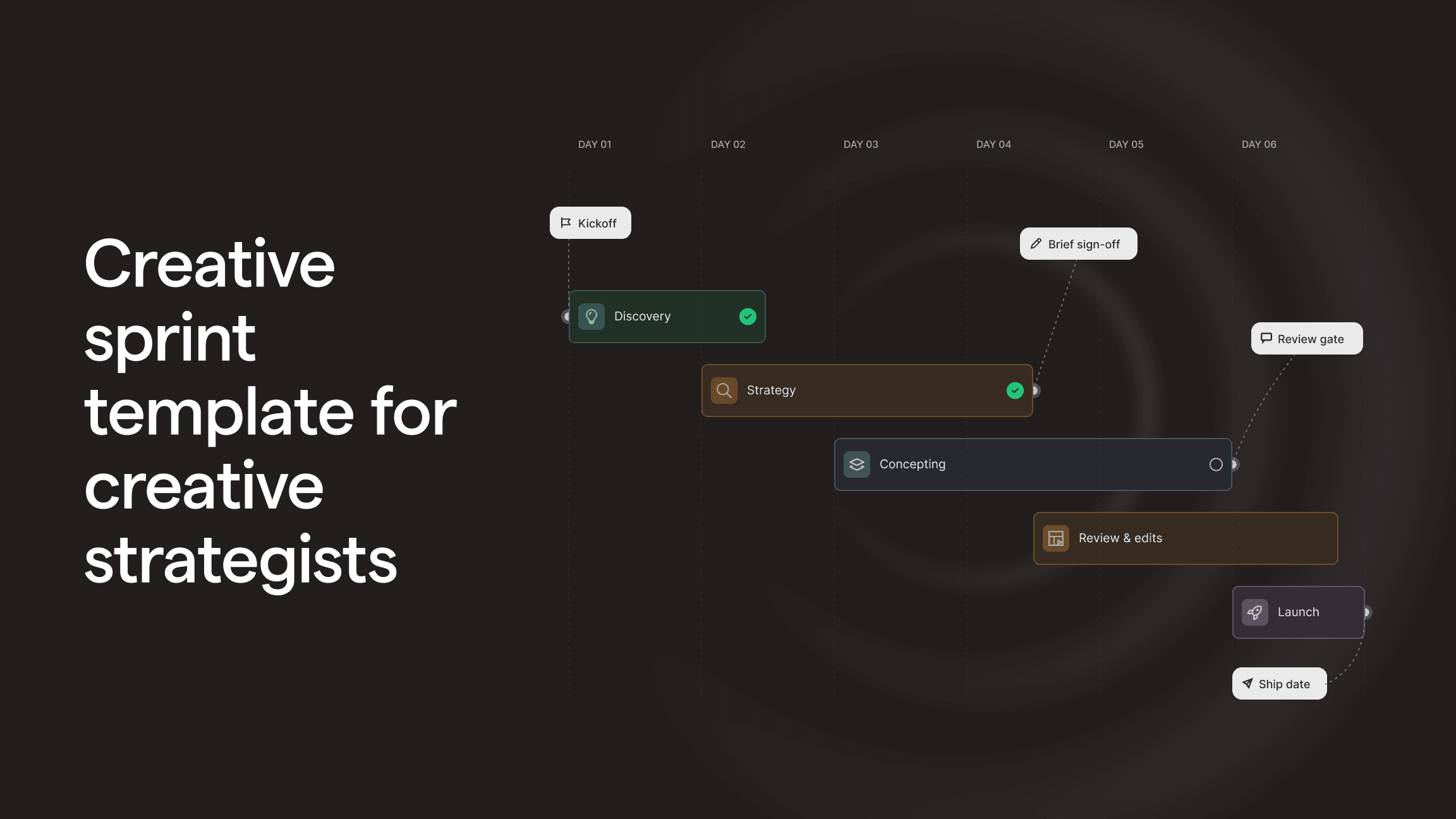
Granola runs two-week sprints. The main week is for a new batch of creatives: big ideas, new directions and a few wild cards. The off week is for iterations, built from a deeper look at what worked in the last batch and in those wild cards. Ads launch in batches at the end of each sprint.
Creators don't fit a two-week rhythm because they need longer lead times, so they run on a monthly cadence with a brief tied to one archetype. We broke the full structure down in our creative sprint template.
3. Bring the makers into a monthly retro
Once a month, Naomi pulls partnership agencies, graphic designers and video editors into a creative retro. Her reasoning: the people who execute briefs usually never hear why something was briefed or why it underperformed, and they often have hypotheses of their own.
The retro never ends with a decision. It covers what happened, why the team thinks it went that way and what to test next month. She keeps the group small enough to avoid "too many chefs", while still wanting the range of opinions. The result is more people thinking in a performance creative mindset instead of only brand or only growth. (Watch: monthly retros, 07:02)
4. Size production from your creative mix
Asked how she forecasts creative volume, Naomi mentioned there's no single right answer. It depends on how fast your creatives fatigue, what your team can actually produce and which formats win on your account. If statics win, volume is cheap. If video wins, every extra concept costs production money.
Her starting point is a production timeline and an inventory: what you already have, and what you can repurpose quickly and cheaply. Then she maps the gaps with a creative mix grid that plots ad volume against brand adherence.
Top, lower volume: evergreen brand topics, campaigns and launches. On-brand visually, carrying the core message.
Middle, the heavy lifting: statics, motion and branded UGC built around archetype messaging and education.
Bottom, highest volume: partnership UGC and channel-native statics where conversion happens.
The core message should hold everywhere. Going through the grid shows the gaps fast: you might have campaign creative, statics, motion and partnership UGC, but no rough-and-ready employee content. From there you test and learn. Start with something like 30 creatives at a given spend level, watch how quickly they fatigue and add more if they burn out faster than you can replace them. (Watch: the creative mix framework, 09:08)
5. Measure hit rate as spend concentration
During the audience Q&A, there was also discussion around hit rates. Naomi's answer moved away from counting winners. Her practical tip was to focus on spent concentration if your goal is reaching new audiences. If you can reduce concentration, it's a good indicator your are reaching more net new people. For example, if 90% of spend goes to 10% of your creatives this month, and 20% of your creatives share that 90% next month, Meta is finding more audiences for more of your work.
She also warned about chasing hit rate on its own terms. Optimise only for winners and you slide toward "winners no matter what", whatever it does to the brand. (Watch: how to measure hit rate, 15:35).
6. Put the why in your naming convention
An audience question on naming conventions led to Naomi's creative taxonomy. Her must-haves are a motivator, barrier or value prop, the target archetype, the source (which creator, agency or freelancer) and the ad type (carousel, partnership ad, motion, video, static).
Tracking these parameters lets you get meaningful audience insights.
For example, if you can see that a particular value prop leads to a longer time as a customer, it makes sense to focus on the one that brings more sticky customers.
The ad type tag can surface simpler creative gaps: for example you can compare which ad formats perform the best vs. what percentage of your creative actually uses those formats.
She analyzes tags at two intervals. Weekly, she checks the testing campaign for what scaled, watches the top 10 ads for sudden swings and looks at what was recently killed and whether it can be revived. Monthly, in the retro, she cuts performance by archetype and motivator to decide where to invest more volume or go back to customer research. (Watch: naming conventions and creative reporting, 21:28)
7. Keep review and handoff in one place
More sources and more freelancers mean more to review and more ways for work to slip. In Focal, every ready-to-review creative from every source lands in one view. Naomi blocks out three hours and works through it, instead of needing to chase 20 different Slack threads.
Handoff used to mean media buyers clicking a link, opening Google Drive and downloading three variations of one concept, then doing it again for the next. Now they get a board link organised by channel and archetype, with a launch date filter so they know what should go live when. They select everything and download it, or upload straight to Meta and YouTube with the naming convention already applied. Andreas pointed out how often approved, paid-for creative never goes live at all. A single handoff view is how you can avoid creative falling through the cracks. (Watch: review and handoff in Focal, 13:15)
8. Let Claude run the loop and keep a human on the words
Naomi's stack has three layers: a creative analysis and research tool, Claude as the agent that pulls context from everything else, and Focal as the production system. Her Claude setup mirrors her week.
Monday, 9 AM: a scheduled weekly creative report.
Iteration task: Claude looks at the right metrics and suggests creatives that need iterations. She reviews the list, then rebriefs through the Focal MCP with a link to the existing asset attached.
After each monthly retro: Claude reads the retro notes through Granola's own MCP, turns the ideas into a list of briefs and creates them as drafts in Focal through the Focal MCP.
Skills: separate instructions for static briefs and video briefs, because Claude "is very good at telling you lots of things, but not really concisely."
There's a review step before anything becomes a brief. Claude is strong when it starts from something real, like rewriting a transcript that's performing for a new audience. It falls short on net-new scripts, which miss the human element, and audiences like Gen Z spot AI-written copy quickly. That's why her iteration task only handles iterations, and why she's recently gone back to writing some lines herself. (Watch: Naomi's Claude workflows, 17:25)
9. Get creative diversity from people, then make every iteration count
On splitting production, Naomi shared a rule she's kept for a while: the large majority on what's working, a smaller share on bets built from learnings (a winning headline in a new format, a winning format for a new audience) and about 10% on wild cards. Whatever the split, it should be anchored in data or customer reviews.
On Andromeda, her advice was to look at micro-personas. A "busy mom" persona further breaks down into a yoga mom, working mom, and tech mom, each with different motivators, barriers and times they scroll. Thinking in micro-personas produces real diversity faster than chasing variation for its own sake. (Watch: creative diversity after Andromeda, 27:01)
For a deeper look at Andromeda and creative diversity, see: Creative diversity under Meta Andromeda.
10. Brief creators with ideas, not scripts
One audience member asked whether to test new scripts with bigger creators. Naomi's answer: she tries not to hand creators scripts at all. You work with creators for their creativity and their platform, so the ad should sound like them. Her monthly creator brief covers the audience, three ideas worth talking about and examples of their own content she wants more of, plus do's, don'ts and visual guidance. The creator writes the script and sends it back for review.
That gives creators ownership, and it moves the responsibility to choosing the right creators in the first place. If you want to test a new script, test the message first in a format you control, like a static or an in-house montage, and hand the proven message to bigger creators after. (Watch: testing new scripts with UGC creators, 32:33)
What a good creative operation looks like in 2026
When talking about what a good creative operation looks like in 2026, Naomi's closing answer was that no setup fits every company. Budget, team, product and channel mix all change it. When working in DTC, she focused on in-house shoots, while she currently uses creator content and motion graphics more heavily.
Two things held across both, and they'd fit almost any creative strategist workflow. You need an AI agent that holds the context around your brand and your conversations, and a reliable production system to forecast what's coming, review it and learn from it. For anyone building their own AI workflow, her advice was to test and learn, and to not get precious about any one setup or creative direction.
Watch the full session: Inside Granola's creative engine on YouTube. The next Focal Point is in early November, with one of the largest consumer apps in the world on scaling creative production across dozens of countries. Register at focal.inc/webinars.